


Quick answer: Wood-grain heat transfer is usually the better choice when you need a highly realistic timber pattern, repeatable colour across a production run, and good scratch resistance on relatively flat metal surfaces. Fluorocarbon wood-grain paint costs more, but it is the stronger specification for coastal exposure, large fabricated shapes, deep letter returns and projects that may need on-site repair. Neither finish is real wood; the right choice depends on the geometry of the sign, the environment and the expected service life.
Wood-effect metal signage is widely used for hotel façades, restaurant entrances, retail interiors, landscape letters, wayfinding panels and heritage-inspired storefronts. It combines the warmth of timber with the dimensional stability, fire performance and fabrication accuracy of metal. The two dominant finishes look similar at a distance, but they are made in very different ways and should not be treated as interchangeable.
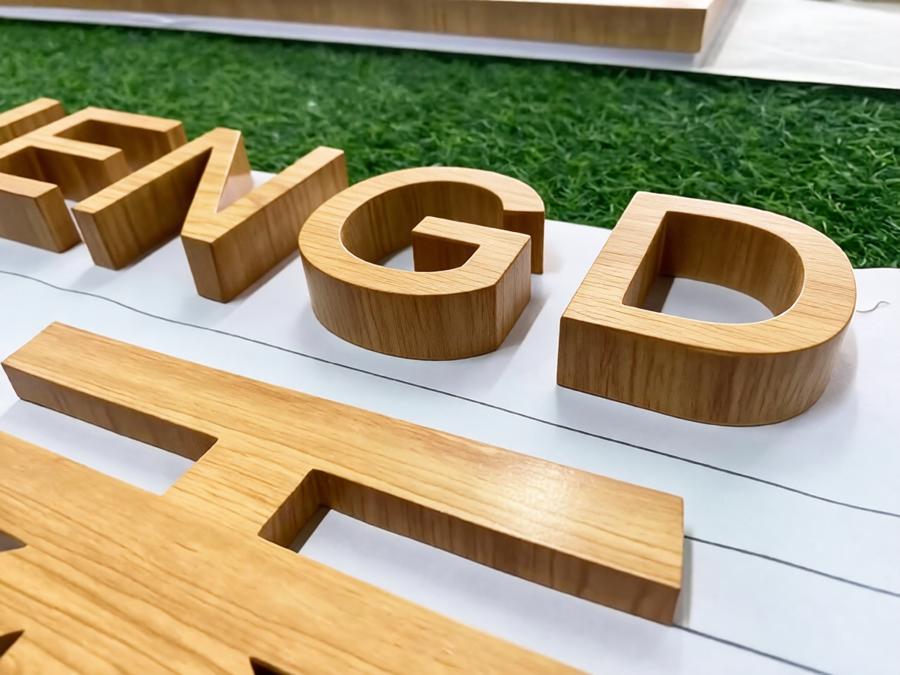
What is wood-grain heat transfer on metal?
The process begins with surface preparation, followed by powder coating the metal with a suitable exterior-grade polyester system. A wood-grain transfer film is wrapped tightly around the coated part and heated. Under controlled temperature and pressure, the pattern is transferred into the softened powder layer. After curing and removing the carrier film, the grain becomes part of the finished coating rather than a pattern sitting loosely on top.
The result is a convincing, repeatable timber appearance with knots, tonal variation and fine linear grain. Heat transfer is particularly effective for flat panels, standard-depth letters and parts where the visible face does not contain narrow internal channels. Our wood-grain heat transfer process guide explains the production steps in more detail.
Advantages of heat transfer
- High visual realism: continuous patterns, subtle knots and natural colour variation are more convincing than a hand-painted grain.
- Good scratch resistance: because the pattern is integrated into the coating, ordinary abrasion is less likely to expose a different colour underneath.
- Consistent batch production: every panel in a multi-site order can use the same film and coating specification.
- Efficient for flat geometry: standard panels and shallow returns can be finished quickly and economically.
- Reliable outdoor performance: an exterior polyester base and correctly cured film commonly provide around 5–8 years of acceptable colour stability in normal inland conditions.
Limitations to plan for
- Deep recesses, narrow channels and highly curved surfaces can transfer unevenly.
- A damaged area is difficult to repair invisibly; refinishing usually means repeating the whole visible face.
- Thin metal can distort during heating and curing.
- The process is carried out in a factory and cannot be used for on-site touch-up.
- An epoxy base is not appropriate for prolonged outdoor exposure, so the powder specification must be checked carefully.
What is fluorocarbon wood-grain paint?
Fluorocarbon wood-grain finishes are built up in layers: preparation, primer, intermediate coat, a grain effect created by brush, roller or hand-drawing, and a protective clear fluorocarbon topcoat. PVDF is the premium system; FEVE coatings occupy a mid-to-high performance position. The grain is created by the finisher, not transferred from a printed film.
This difference matters on complex fabricated letters. A painter can work the pattern into internal returns, curved faces, welded seams and large three-dimensional forms that are difficult to wrap with transfer film. It also allows a damaged visible area to be recoated or retouched after installation, although the quality of the repair depends on the applicator.
Advantages of fluorocarbon wood-grain paint
- Excellent weather resistance: properly specified PVDF systems commonly target 10–15 years of outdoor performance.
- Broad shape freedom: suitable for deep cavities, curved surfaces, oversized fabricated letters and mixed-geometry assemblies.
- Repairability: minor damage can be treated on site without replacing the entire panel.
- Dense protective film: good resistance to dirt, oils, cleaning agents and some chemical exposure.
- Suitable for coastal projects: when paired with the correct stainless steel grade and preparation, it offers a more robust long-term specification.
Limitations to plan for
- The grain is an artisan effect, so it may look more “painted” than natural timber.
- Appearance can vary between batches or applicators unless strict samples are approved.
- The coating feels smooth and usually lacks the tactile texture of a transfer-printed surface.
- Multiple coats, specialist labour and longer curing make it the more expensive option.
- “Fluorocarbon” is sometimes used loosely; confirm whether the specified resin is PVDF, FEVE or a lower-grade imitation.
Heat transfer vs fluorocarbon wood-grain paint
| Decision factor | Wood-grain heat transfer | Fluorocarbon wood-grain paint |
|---|---|---|
| Grain realism | Excellent; continuous printed texture | Good; hand-applied appearance |
| Outdoor service life | About 5–8 years with exterior polyester | Typically 10–15 years with PVDF |
| Complex shapes | Best on flat faces and shallow returns | Excellent on deep, curved and irregular forms |
| Batch consistency | High when the same film is used | Dependent on the painter and approved sample |
| Local repair | Difficult and usually visible | Possible on site |
| Scratch resistance | Generally slightly better | Good, but dependent on the full coating system |
| Relative cost | Medium | High |
| Best production volume | Batch and repeat orders | Complex or lower-volume custom work |
How to choose by application
Choose heat transfer for repeatable flat signage
Heat transfer is a strong fit for restaurant and hotel custom metal letters and signs, flat façade panels, repeated wayfinding plates, standard landscape letters and interior feature walls. It gives designers a detailed timber appearance while keeping the strength and dimensional accuracy of metal. It is also easier to keep visually consistent when the same brand is rolled out across several locations.
Choose fluorocarbon paint for difficult shapes and harsh exposure
Select fluorocarbon wood-grain paint for outdoor signage near the coast, very large 3D letters, deep channel returns, complex curved fabrications and sites where maintenance access is limited. It is also the safer choice when a client expects a long service interval or may need a local repair after installation.
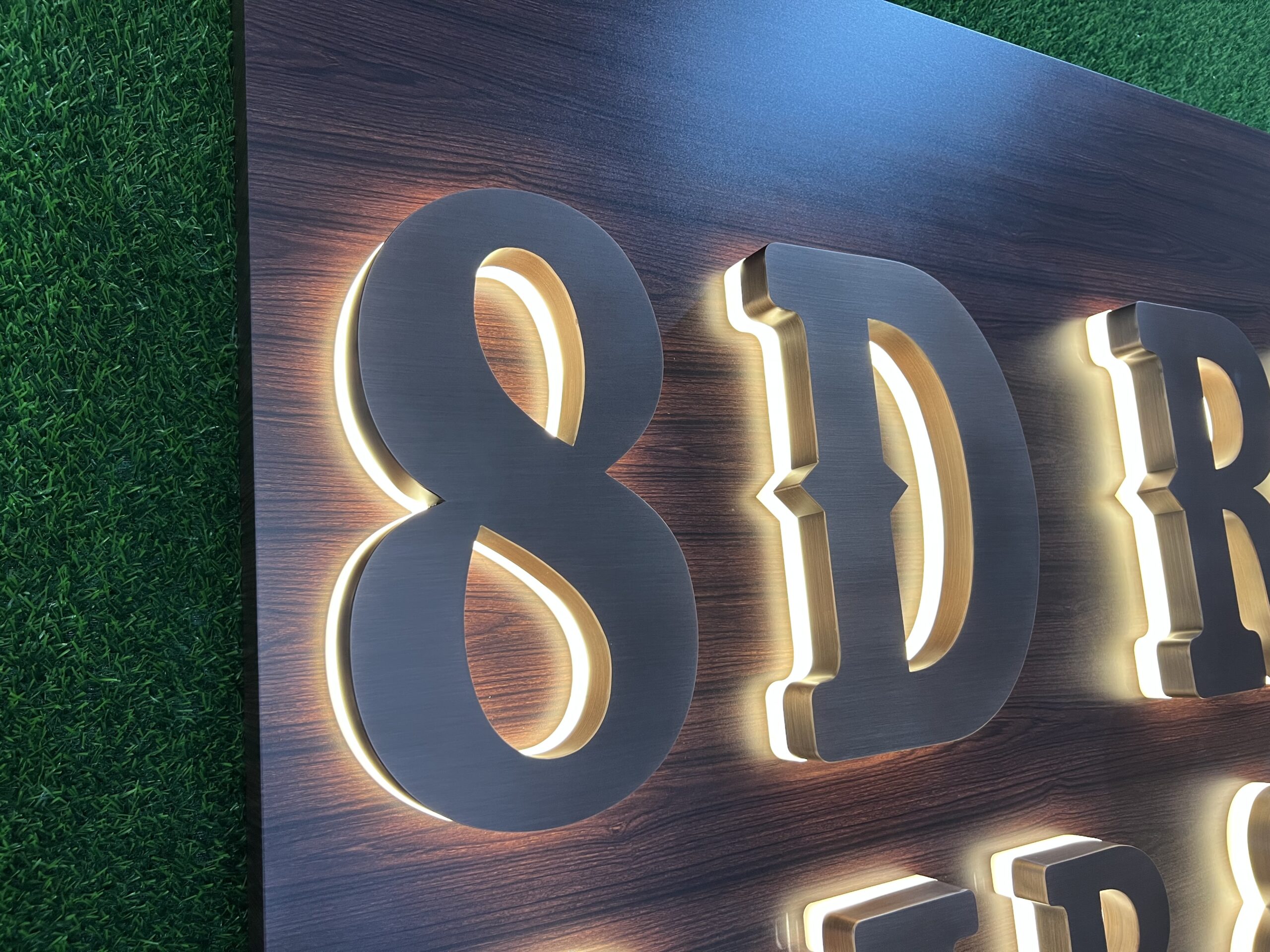
If the sign includes illumination, the coating specification must be coordinated with the lighting detail. See our guide to custom LED letter signage before finalizing sample colours, because warm white light can make a brown wood grain appear redder, while cool white light can flatten its warmth.
Do not overlook the metal substrate
The finish is only one part of the specification. Mild steel, aluminium, 201 stainless steel, 304 stainless steel and 316 stainless steel behave differently in humidity, salt air and urban pollution. Review the stainless steel and aluminium material guide before selecting the base metal.
For an inland storefront, 304 stainless steel or a suitably prepared aluminium panel may be sufficient. For coastal or chemically exposed locations, 316 stainless steel is usually the more appropriate starting point. The substrate grade, pre-treatment and coating system must be considered together; a premium topcoat cannot compensate for poor surface preparation.
Quality checks before approving production
- Approve a physical sample under the actual lighting. Screen colours and small swatches can look very different on a finished façade.
- Confirm the powder type. Outdoor heat-transfer work should use an exterior polyester base, not an unspecified or epoxy-only system.
- Name the resin system. For fluorocarbon paint, require PVDF or approved FEVE rather than accepting a generic “fluorocarbon” description.
- Review the geometry. Mark deep returns, tight internal corners and curves on the drawing before choosing transfer or paint.
- Agree on touch-up responsibility. A painted finish may be repairable, but the correct touch-up materials and method should be supplied.
- Check coating compatibility. Primer, topcoat, clearcoat and sealants must form a compatible system; mixing products from unrelated suppliers creates avoidable failure risk.
For powder-coated and painted systems, the powder coating vs fluorocarbon paint comparison explains the difference between film durability, colour range and suitability for export packing. Coastal projects should also follow a coastal signage specification that covers grade selection, fasteners, drainage and maintenance.
Common specification mistakes
Three problems appear repeatedly. First, buyers compare only the appearance of a small sample and overlook the powder base, resin type and warranty conditions. Second, deep letter returns are approved from a flat test panel, even though transfer film may bridge or distort in those areas. Third, the sign is described as “wood-look metal” without stating whether the grain must be consistent across a multi-site order or whether future local repair is a requirement.
A precise request should identify the substrate, metal thickness, coating system, colour sample, gloss level, exposure class, grain direction, repair expectation and approved packing method. Those details prevent a low-cost sample from becoming an expensive site problem.
Final recommendation
Choose heat transfer when realism, consistent batch appearance and value matter most on flat or moderately formed metal. Choose fluorocarbon wood-grain paint when weather resistance, complex geometry and repairability justify the higher cost. For inland retail and interior projects, heat transfer is often the practical choice. For coastal installations, deep fabricated letters and long-life architectural work, fluorocarbon paint is usually the more defensible specification.
References
Technical background: dye-sublimation printing, powder coating, PVDF, fluoropolymer coatings, stainless steel and aluminium.