


RGB, RGBW and RGBIC are often listed as if they were three grades of the same LED strip. They are not. All three can produce color, but they solve different problems: RGB mixes three colors, RGBW adds a dedicated white channel, and RGBIC adds individual control along the strip. The right choice depends on whether the sign needs an accurate white, a smooth gradient, a simple color change or a full animation.
This guide explains how each system works, what it costs in practice, and where each one fits in illuminated letters and signage. It is written for buyers comparing a storefront logo, a bar sign, a hotel feature wall or a large exterior letter set.
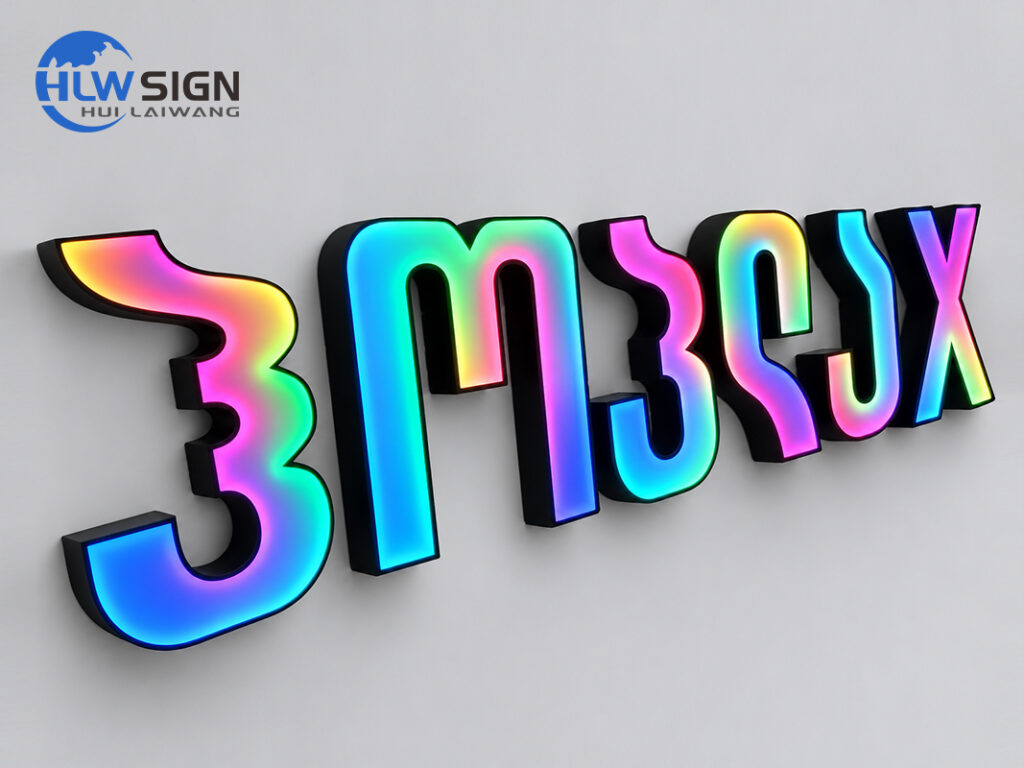
What Is RGB Lighting?
RGB uses three LED channels: red, green and blue. By dimming each channel independently, the controller can mix millions of colors; the RGB color model explains the additive principle behind that mix. White is produced by combining all three channels, which works well for many decorative effects but can look slightly cool, pink or green depending on the LEDs and diffusion. Every LED on a standard RGB strip usually shows the same color at the same time.
RGB is the most cost-effective of the three systems. It needs a three-channel controller and a relatively simple power supply, and it is widely available in strips and modules. For a colorful RGB LED letter project, it is a good fit when the goal is color change, pulse, fade or a fixed brand color rather than a precise white.
The limitation is white quality and effect resolution. If the brand uses warm white, neutral white or a very specific pastel, RGB may not reproduce it cleanly. It also cannot create a gradient along a single run; the whole run changes together unless you split it into separately controlled zones.
What Is RGBW Lighting?
RGBW adds a fourth channel: a dedicated white LED. That white can be warm, neutral or cool depending on the product. The controller can use the white channel on its own for clean white light, or mix it with RGB for pastels and softer tones. The result is better white quality and more natural skin tones, product colors and architectural whites.
RGBW is often the better choice for premium retail, hotel lobbies, restaurants and brand logos that need a clean white most of the time and color only for campaigns. It still behaves like a single-zone system unless you add multiple controllers. The trade-off is a slightly higher bill of materials, a four-channel controller and a power supply sized for the extra channel.
For a rgb channel letters project, RGBW can be a practical middle ground: the sign can show a precise white for everyday branding and switch to color for promotions or events.
What Is RGBIC Lighting?
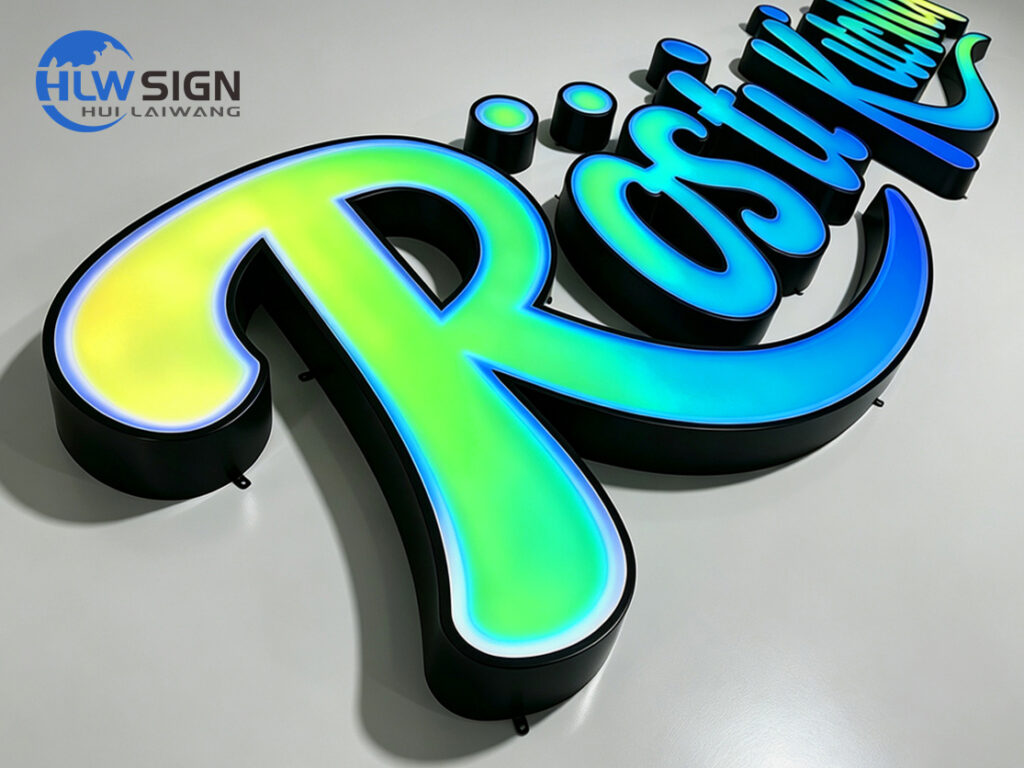
RGBIC adds an integrated circuit that allows the strip to be controlled in segments or pixels. Instead of one color for the whole run, the controller can address sections independently. That is what enables chasing, color gradients, moving effects, rainbow fades and animations along the letter.
“RGBIC” is a broad label. Some products control small segments; others control individual LEDs. The effect quality, wiring complexity and price depend on the IC count and the controller. A true pixel-mapped installation needs a compatible controller, data wiring, power injection and often a programming step. It is not simply an RGB strip with a different remote.
RGBIC is the most expensive and most complex option, but it creates effects that RGB and RGBW cannot. It suits entertainment venues, bars, nightclubs, event signage, feature walls and brands that want motion as part of the identity. For a large sign, the design should include voltage-drop calculations, spare segments and access for service.
RGB vs RGBW vs RGBIC: Quick Comparison
| Consideration | RGB | RGBW | RGBIC |
|---|---|---|---|
| LED channels | Red, green, blue | Red, green, blue, white | Red, green, blue plus an IC for addressable control |
| White quality | Mixed white; can look cool or tinted | Dedicated white; cleaner and more consistent | Depends on the strip; white is usually mixed unless it is RGBWIC |
| Color range | Millions of mixed colors | Millions of colors plus clean white and pastels | Millions of colors with per-segment or per-pixel effects |
| Dynamic effects | Whole run changes together | Whole run changes together | Gradients, chasing, animation and pixel effects |
| Controller | Three-channel controller | Four-channel controller | Addressable controller or app-based system |
| Wiring and power | Simple | Simple, slightly higher load | Data wiring, power injection and voltage-drop planning |
| Relative cost | Lowest | Moderate | Highest |
| Best fit | Color-changing signs on a budget | Brand signs that need clean white plus color | Entertainment, feature walls and animated signage |
How They Work
All three systems use pulse-width modulation (PWM) to dim the LED channels. The controller switches each channel on and off rapidly; the ratio of on-time to off-time sets the perceived brightness. The difference is how many channels are controlled and whether the strip has addressable ICs.
RGB and RGBW are usually controlled by a remote, a wall controller or a DMX decoder. RGBIC systems use an addressable data protocol, often a serial protocol driven by a dedicated controller. Professional installations may use DMX512 for scene control; the DMX512 standard is a common reference for lighting control networks. Addressable strips such as the WS2812B family integrate the driver and control circuit into the LED package; the WS2812B datasheet shows the data timing and wiring requirements.
Outdoor signs add another layer: ingress protection. An IP rating describes how well the enclosure resists dust and water; the IEC 60529 standard defines the IP code. For an exterior sign, the LED strip, connectors, power supply and letter enclosure all need to be specified for the actual exposure, not just labelled “waterproof”.
LED efficiency and lifetime also depend on the whole system: the LED, the driver current, thermal design and the power supply. The U.S. Department of Energy’s LED Basics explains the relationship between LED efficiency, heat and useful life. A cheap strip driven hard in a sealed letter can fail long before its rated life.
What Drives the Cost?
The strip price is only one line item. RGB is usually the lowest-cost system because it needs three channels and a simple controller. RGBW adds a white channel, a four-channel controller and a larger power supply. RGBIC adds ICs, data wiring, a more capable controller and often programming and commissioning time.
For a large sign, the bigger cost drivers are LED count, power supply capacity, wiring, voltage-drop management, access for service and the labour to install and program the system. A low-cost RGBIC strip can become expensive if it needs power injection every few metres, a custom controller and a technician to map the effects. Ask for a complete bill of materials, not a per-metre strip price.
Which One Fits Your Application?
Storefront logos and channel letters: RGBW is often the best balance when the sign needs a clean white for daily branding and color for promotions. A simple RGB system is enough if the design only needs a fixed color or a basic color cycle. For a colorful rgb sign board, confirm the white quality and the controller before production.
Bars, nightclubs and entertainment venues: RGBIC creates the chasing and gradient effects that suit a dynamic venue. Plan the power injection, data run and controller location early; retrofitting them into a finished letter is expensive.
Premium retail and hotels: RGBW gives a more controlled white and softer pastels. If the brand relies on a specific white, test the actual LED and diffuser together rather than choosing from a color chart.
Events and temporary installations: RGB or RGBIC can work, depending on whether the design needs animation. For a reusable rgb marquee letters set, choose a controller that is easy to reset and a power supply that can handle repeated setup and transport.
Luxury and decorative letters: rgb diamond letters and faceted faces can look spectacular with RGB or RGBIC, but the diffusion and LED spacing matter more than the number of colors. A dense, even layout usually looks better than a sparse strip with a wide color range.
Neon-style signage: rgb neon letters use a different light source and diffusion method. Compare the look, not just the control system; a neon-style sign and a channel letter can produce very different line quality.
Common Mistakes
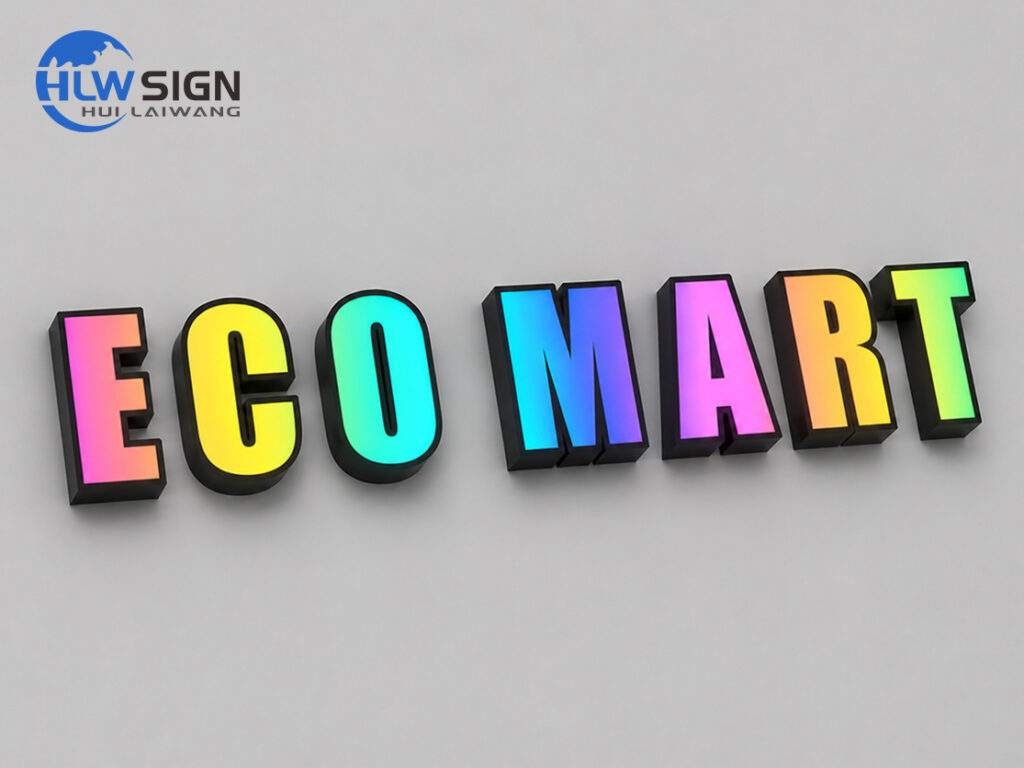
The most common mistake is using RGB white for a brand that needs a clean white. Mixed white can look slightly blue, green or pink, especially next to printed materials or interior lighting. RGBW solves that problem, but only if the white channel is the correct color temperature.
Another mistake is treating RGBIC as a drop-in upgrade. Addressable strips need data wiring, a compatible controller and careful power planning; long runs can suffer voltage drop and color shift. A third mistake is undersizing the power supply or ignoring heat inside a sealed letter. Finally, buyers often forget service access: a controller or a failed segment should be reachable without dismantling the whole sign.
Specification Checklist
- Control type. State RGB, RGBW or RGBIC and the number of zones or pixels. “RGBIC” alone is not a specification.
- White quality. For RGBW, specify the white color temperature and CRI target. For RGB, test the mixed white against the brand standard.
- LED density and diffusion. Confirm the LED pitch, face thickness and diffuser grade so the face looks even at the intended viewing distance.
- Controller and protocol. Confirm whether the controller is remote-based, DMX or addressable, and who supplies the programming.
- Power and voltage drop. Check the power supply capacity, voltage, cable gauge and injection points for the actual run length.
- Ingress protection. Specify the IP rating for the strip, connectors, power supply and enclosure; refer to IEC 60529 for the meaning of the digits.
- Thermal design. Confirm the LED current and heat path. A sealed letter needs a thermal plan, not just a bright strip.
- Service and spares. Ask for spare segments, a controller spare and a wiring diagram. Label the data and power runs.
Frequently Asked Questions
Is RGBW better than RGB?
RGBW is better when the sign needs a clean, consistent white or soft pastel colors. RGB is usually enough for decorative color change and is less expensive. The right choice depends on how important white quality is to the brand.
Is RGBIC the same as addressable LED?
RGBIC generally means the strip has integrated control ICs that allow segments or pixels to be addressed. The exact resolution depends on the product. Ask how many ICs or zones the strip has, not just whether it is labelled RGBIC.
Can RGBIC create gradients in channel letters?
Yes, if the strip is addressable and the controller supports the effect. The quality depends on pixel density, diffusion and the mapping of the letter. A low-density strip may show visible steps rather than a smooth gradient.
Which system is best for outdoor signs?
All three can be used outdoors if the LEDs, connectors, power supply and enclosure are rated for the exposure. IP rating, sealing, drainage and thermal design matter more than the control type. Confirm the IP rating for the complete assembly.
Why does my RGB white look blue or green?
RGB white is mixed from red, green and blue LEDs, and the result depends on the LED bins and the diffuser. A different bin, a different face material or a different controller setting can shift the white. RGBW avoids this by using a dedicated white channel.
Does RGBIC cost much more?
Usually yes, because of the ICs, controller, data wiring and programming. The difference grows with the number of pixels and the complexity of the effect. Compare the complete installed cost, including power injection and commissioning.
Conclusion
RGB, RGBW and RGBIC are three different answers to the same question: how much color control does the sign actually need? RGB is the simple, cost-effective choice for color change. RGBW adds a clean white channel for brand-critical signage. RGBIC adds addressable effects for entertainment and feature walls, at a higher cost and complexity.
Choose the system after you know the white quality, effect, viewing distance, power layout and service plan. If you are planning a project, send the letter sizes, artwork, lighting effect and installation environment; HLW Sign can review the control system and prepare a custom signage plan with a wiring diagram and sample plan.