
When ordering custom channel letters, one of the first material decisions is often stainless steel or aluminum.
Both materials are widely used for commercial signage, and both can produce durable, professional channel letters. However, they behave very differently in terms of appearance, weight, fabrication, corrosion resistance, installation, cost and long-term maintenance.
For a small indoor logo, the material difference may have little impact on the project. For a 5-meter storefront sign, rooftop letters, a coastal hotel or a large international project, choosing the right metal can affect everything from structural load to shipping cost.
At HLW Sign, we manufacture both stainless steel channel letters and aluminum channel letters for indoor and outdoor projects. Rather than treating one material as universally better, we normally select the material according to the building, environment, desired finish, letter size and budget.
This guide explains the differences from a sign manufacturer’s perspective.
Stainless Steel vs Aluminum Channel Letters: Quick Comparison
| Factor | Stainless Steel | Aluminum |
|---|---|---|
| Weight | Heavier | Much lighter |
| Corrosion resistance | Excellent with correct grade | Very good |
| Premium metal appearance | Excellent | Usually requires painting/coating |
| Brushed/mirror finish | Excellent | Less commonly selected |
| Fabrication | More demanding | Easier to form |
| Large letters | Suitable but heavier | Excellent |
| Coastal applications | 316 stainless recommended for demanding environments | Suitable with appropriate alloy/coating |
| Installation load | Higher | Lower |
| International shipping | Higher weight | Lower weight |
| Custom paint colors | Available | Excellent |
| Premium architectural signs | Excellent | Good |
| Large storefront projects | Good | Excellent |
The right material depends on what the sign needs to accomplish.
What Are Stainless Steel Channel Letters?
Stainless steel channel letters are fabricated three-dimensional letters in which the face, sides, back or a combination of these components are made from stainless steel.
They may be illuminated or non-illuminated.
Common constructions include:
- Front-lit letters with acrylic faces
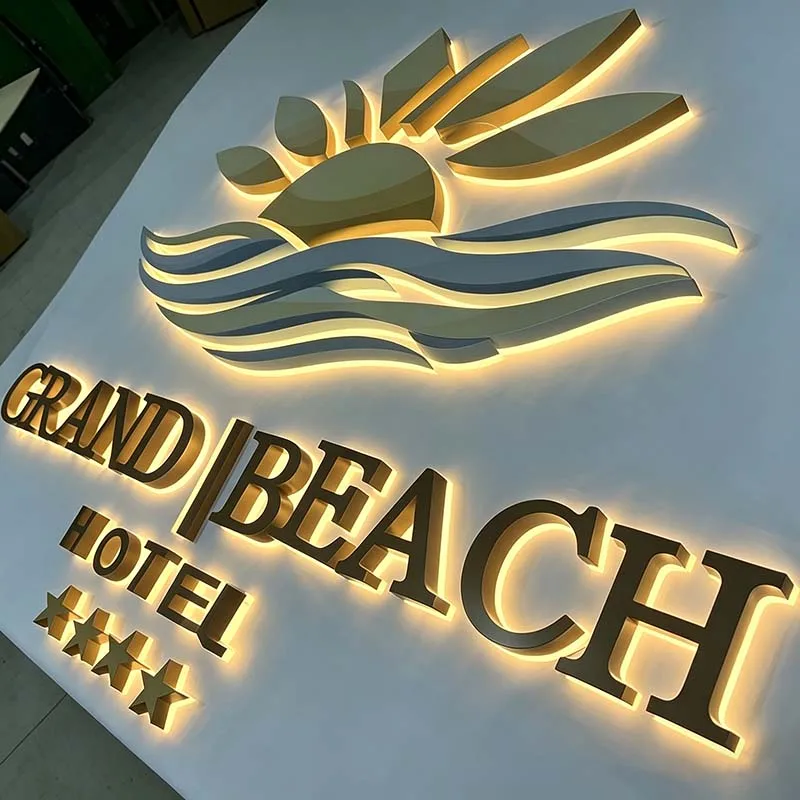
- Backlit or halo-lit stainless steel letters
- Front-and-back illuminated letters
- Non-illuminated fabricated metal letters
- Perforated illuminated letters
- Brushed or mirror-finished logo signs
One of the main reasons buyers choose stainless steel is appearance.
Unlike painted sheet metal, stainless steel can become the finished decorative surface itself.
Popular finishes include:
- Brushed silver
- Mirror silver
- Brushed gold
- Mirror gold
- Rose gold
- Champagne gold
- Black titanium
- Painted stainless steel
This makes stainless steel particularly attractive for hotels, restaurants, salons, corporate offices and premium retail projects.
For an example of how metal selection affects halo-lit construction, see our internal guide on Backlit Channel Letters.
What Are Aluminum Channel Letters?
Aluminum channel letters use lightweight aluminum sheet or channel letter coil for the returns, backs or structural components of the letters.
Aluminum has been widely adopted by the sign industry because it combines low weight with good corrosion resistance and easy fabrication.
It is particularly suitable for:
- Large storefront letters
- Shopping center signage
- Rooftop signs
- Chain-store branding
- Large illuminated logos
- Raceway-mounted signs
- Projects requiring lower structural weight
Unlike stainless steel, aluminum is usually painted, powder coated or otherwise finished rather than left with a decorative mirror or brushed surface.
That makes aluminum channel letters especially useful when the brand requires an exact RAL, Pantone or corporate color.
1. Appearance: Stainless Steel Has the Premium Metal Advantage
Appearance is often the clearest reason to choose stainless steel.
A brushed stainless-steel face reflects light differently from painted aluminum and gives the letter a distinctly architectural look.
For example:
Brushed stainless steel + 3200K halo lighting
can create a sophisticated effect suitable for:
- Hotels
- Restaurants
- Luxury stores
- Beauty salons
- Corporate headquarters
- Reception areas
Mirror gold or brushed gold stainless steel can also provide a decorative surface without relying entirely on paint.
This is one area where stainless steel channel letters have a clear design advantage.
When Aluminum Looks Better
Aluminum becomes particularly useful when color is more important than exposed metal.
For example, if a company requires:
- RAL 3020 red
- Pantone-matched blue
- Matte black
- Custom turquoise
- Brand-specific green
painted aluminum channel letters provide excellent flexibility.
For storefront signs where customers mainly see illuminated acrylic faces at night, the difference between a painted aluminum return and painted stainless-steel return may be difficult to notice.
In those situations, paying for a decorative stainless-steel finish may not provide meaningful visual benefit.
2. Weight: Aluminum Has a Major Advantage
Weight is one of the biggest practical differences between stainless steel and aluminum.
Aluminum has a density of roughly one-third that of stainless steel.
This matters more as the sign becomes larger.
Consider a small reception logo measuring 600 mm wide. The weight difference may have little effect.
Now consider:
- 1-meter-high letters
- 6-meter-wide storefront signage
- Rooftop letters
- Large pylon-mounted logos
- Multi-set shopping mall projects
The difference becomes significant.
Lightweight aluminum channel letters can reduce:
- Load on the façade
- Mounting hardware requirements
- Installation labor
- Raceway weight
- Packaging weight
- International freight cost
For buildings with lightweight aluminum composite panels or limited structural support, this can be particularly important.
3. Corrosion Resistance: Environment Matters More Than the Material Name
Both materials offer good corrosion resistance when correctly specified.
However, saying that a sign is simply “stainless steel” is not enough.
There are different stainless-steel grades.
201 Stainless Steel
201 stainless steel is economical and can be suitable for indoor environments or relatively dry, protected applications.
At HLW Sign, it may be considered for projects where environmental exposure is limited and budget is a priority.
For demanding exterior projects, we normally evaluate the environment before selecting it.
304 Stainless Steel
304 is one of the most commonly selected grades for commercial stainless steel channel letters.
It provides a practical combination of:
- Corrosion resistance
- Appearance
- Fabrication performance
- Cost
For normal outdoor commercial environments away from significant salt exposure, 304 is often a practical choice.
316 Stainless Steel
316 contains molybdenum, giving it improved resistance in chloride-containing environments.
For this reason, 316 is often considered for:
- Coastal areas
- Islands
- Seaside hotels
- Marine environments
- Swimming pool areas
- Locations exposed to salt spray
According to World Stainless, chloride exposure, salt spray and proximity to coastal or marine environments are important factors when selecting stainless steel for architectural applications. For projects installed near the sea, the environmental exposure should therefore be evaluated before choosing between 304 and 316 stainless steel.
What About Aluminum?
Aluminum naturally forms a protective oxide layer, giving it good corrosion resistance.
For commercial signage, painted or coated aluminum can perform very well outdoors when the surface treatment and fabrication are properly executed.
However, the environment still matters.
Cut edges, fasteners, dissimilar metals and coating damage all need to be considered in long-term outdoor installations.
4. Coastal Signs: Should You Use Aluminum or 316 Stainless Steel?
Coastal signage deserves special attention.
Salt, humidity and wind-driven moisture create conditions that are considerably more aggressive than a normal inland storefront.
For premium exposed-metal signage in coastal locations, 316 stainless steel channel letters are often a strong choice.
This is especially relevant for:
- Caribbean resorts
- Maldives projects
- Coastal restaurants
- Island retail stores
- Beachfront hotels
- Marina signage
However, using 316 stainless steel does not automatically make the entire sign corrosion-proof.
The manufacturer also needs to consider:
- Mounting studs
- Screws
- Welded areas
- Cable entry points
- Internal frames
- Power-supply enclosures
- Drainage
A 316 face combined with inappropriate hardware can still create maintenance problems.
Material specification should therefore cover the complete sign rather than only the visible face.
5. Fabrication: Aluminum Is Easier to Form
From a production perspective, aluminum is easier to bend and form than stainless steel.
This is important when manufacturing:
- Curved letters
- Script fonts
- Small-radius corners
- Large quantities
- Deep channel letters
Modern automatic channel-letter bending equipment works very efficiently with aluminum coil.
As a result, aluminum channel letters are well suited to standardized retail programs or projects containing many large letters.
Stainless steel normally requires different fabrication techniques.
Depending on the design, production may involve:
- Laser cutting
- CNC bending
- Hand forming
- Welding
- Laser welding
- Grinding
- Polishing
- Brushing
- Electroplating
The final surface quality is particularly important because the metal may remain visible.
Poor welding or polishing can be immediately visible on mirror or brushed stainless steel.
6. Lighting: Both Materials Work With Modern LED Channel Letters
The choice between stainless steel and aluminum does not determine whether the sign can be illuminated.
Both materials can be used for:
Front-Lit Channel Letters
An acrylic face allows LEDs inside the letter to illuminate forward.
Backlit Channel Letters
An opaque metal face directs LED light toward the wall, creating a halo.
Front and Back Lit Channel Letters
An illuminated acrylic face provides strong readability while rear lighting creates an additional halo.
Read our guide to Front and Back Lit Channel Letters if your project requires both effects.
Perforated Letters
Small perforations can be added to metal surfaces so LED light shines through the metal itself.
HLW Sign also manufactures custom perforated LED channel letters using stainless steel, aluminum and other metal structures.
7. Stainless Steel vs Aluminum Channel Letters: Cost
There is no single answer to which material costs more.
In many basic configurations, aluminum is economical because:
- It is lightweight
- It is easy to fabricate
- It is efficient for large letters
- Less labor may be required
However, material alone does not determine the final price of custom channel letters.
Other major cost factors include:
- Letter height
- Total sign width
- Number of letters
- Font complexity
- Return depth
- Acrylic thickness
- LED quantity
- Lighting type
- Metal finish
- Mounting structure
- Electrical components
- Packaging
- Shipping
A simple brushed stainless-steel sign can sometimes be less complicated to manufacture than a painted aluminum sign requiring multiple custom colors and complex detailing.
Therefore, comparing only raw material price can be misleading.
For a better understanding of sign pricing, see our internal guide on What Affects LED Sign Price?.
8. Shipping Cost: Aluminum Can Save Money on Large Projects
For international buyers, material choice affects more than factory price.
Shipping can become a major part of the final landed cost.
Aluminum’s low weight makes it attractive for:
- Large signs
- Multiple-store rollouts
- Air freight
- Express delivery
- Large architectural logos
However, shipping cost is often calculated using both actual weight and volumetric weight.
That means simply making a sign lighter does not always reduce freight dramatically.
Packing dimensions matter too.
A well-designed structure that reduces letter depth or allows efficient crate arrangement can sometimes save more freight than changing metal.
HLW Sign regularly ships custom signage internationally using protective foam, reinforced cartons and wooden cases depending on project requirements.
Read more about our International Shipping for Signs process.
9. Installation: Aluminum Is Easier for Large Letters
A lighter sign generally makes installation easier.
For large aluminum channel letters, installers may benefit from:
- Easier lifting
- Reduced façade loading
- Simpler handling
- Smaller mounting structures
- Easier rooftop installation
Stainless steel remains entirely practical for most normal commercial letters, but mounting requirements become more important as size increases.
For either material, the manufacturer should know the wall type before final production.
Common mounting surfaces include:
- Concrete
- Brick
- ACP
- Stone
- Steel cladding
- Wood
- Drywall
- Glass
A professional installation package can include:
- Threaded studs
- Expansion bolts
- Spacers
- Wiring diagram
- Power supplies
- Mounting hardware
- 1:1 installation template
For overseas orders, the full-size template is especially useful because the local installer does not need to measure each individual letter position manually.
10. Electrical Safety Matters More Than the Metal Choice
For illuminated signs, metal quality is only one part of long-term reliability.
The electrical system matters just as much.
Buyers should evaluate:
- LED quality
- LED spacing
- Waterproof connections
- Cable protection
- Power-supply loading
- Grounding
- Drainage
- Accessibility for maintenance
For North American projects, UL Solutions identifies UL 48 as a key standard covering electric signs, while related requirements apply to sign components and LED systems.
Professional external reference: UL Solutions – Electric Sign Certification and Sign Component Solutions.
This is particularly relevant to outdoor custom channel letters, where moisture and electrical components exist inside the same structure.
11. Which Material Is More Durable?
Both materials can provide long service life when used correctly.
The better question is:
Which material is more appropriate for this environment and construction?
Choose stainless steel when:
- A premium exposed metal finish is required
- Brushed or mirror effects are important
- The sign is architectural rather than purely functional
- High surface rigidity is desirable
- 304 or 316 corrosion resistance is required
Choose aluminum when:
- Lower weight matters
- Letters are very large
- Custom painted colors are required
- Installation load needs to be minimized
- Freight weight matters
- Large-volume production is required
Neither material compensates for poor fabrication.
Water ingress, poor LED placement, insufficient drainage, inadequate coating, weak welds or unsuitable hardware can reduce the service life of either type.
12. Stainless Steel vs Aluminum by Application
Retail Storefront
Recommended: Aluminum or stainless steel.
Painted aluminum channel letters are excellent for large front-lit retail signs.
Stainless steel is worth considering when exposed metal is part of the brand image.
Hotel
Recommended: Stainless steel.
Brushed or gold stainless steel channel letters combined with warm-white halo lighting often complement premium architecture.
Shopping Center
Recommended: Aluminum.
Large quantity, lightweight construction and color flexibility make aluminum practical.
Corporate Reception
Recommended: Stainless steel.
Brushed stainless steel creates a clean architectural appearance even when the sign is switched off.
Rooftop Sign
Recommended: Aluminum in many projects.
The lower structural weight can be a significant advantage.
Coastal Resort
Recommended: Evaluate 316 stainless steel or appropriately engineered aluminum.
The final specification should take salt exposure, coating, hardware and maintenance into account.
Real Project Example: Premium Halo-Lit Stainless Steel Letters
Consider a commercial project requiring brushed metal letters with warm-white halo illumination.
The client wanted:
- Visible brushed metal during the day
- Approximately 3200K backlighting
- Individual wall-mounted letters
- No visible backing board
- A premium architectural appearance
In this case, stainless steel was the logical choice.
The brushed face became part of the design itself, while the LEDs provided a soft halo at night.
Using painted aluminum would have produced a perfectly functional sign, but it would not have achieved the same exposed-metal appearance.
This illustrates an important principle:
Material should follow the intended visual effect.
Real Project Example: Large Front-Lit Storefront Letters
Now consider a large commercial storefront.
The priorities are:
- Large letters
- Strong face illumination
- Low structural weight
- Easy installation
- Brand-specific painted returns
Here, aluminum channel letters may provide the better balance.
The customer mainly sees the illuminated acrylic face rather than the metal return, so a premium brushed stainless finish provides limited additional benefit.
The lighter aluminum structure also simplifies installation.
Again, neither material is universally better.
The project determines the answer.
What About Hybrid Construction?
Not every sign needs to use one material throughout.
A custom channel letter can combine materials according to function.
For example:
- Stainless steel face
- Stainless steel return
- Acrylic back
- Aluminum mounting frame
or:
- Acrylic face
- Aluminum return
- Aluminum back
- Stainless decorative trim
Hybrid construction allows the manufacturer to balance appearance, weight and cost.
This can be particularly useful in large custom signage projects.
How HLW Sign Selects Channel Letter Materials
At HLW Sign, material selection begins with the installation environment rather than a fixed specification.
For each project, we normally consider:
- Indoor or outdoor installation
- Coastal or inland environment
- Letter dimensions
- Building structure
- Required metal finish
- Lighting method
- Wall surface
- Installation method
- Shipping destination
- Project budget
Our factory can manufacture channel letters using:
- 201 stainless steel
- 304 stainless steel
- 316 stainless steel
- Aluminum
- Galvanized steel
- Acrylic
- ACP and other supporting materials
We also support front-lit, halo-lit, front-and-back-lit, RGB/RGBW and perforated lighting structures.
Before shipment, illuminated signage can be tested and customers can review finished-product photos or videos.
Stainless Steel vs Aluminum Channel Letters: Final Recommendation
Choose stainless steel channel letters when the metal itself is an important visual part of the sign.
They are particularly suitable for premium architectural projects, brushed or mirror finishes, hotels, restaurants, salons, office buildings and halo-lit signage.
Choose aluminum channel letters when lightweight construction, large size, painted brand colors and installation efficiency are the priorities.
They are particularly effective for large storefronts, shopping centers, rooftop signs and multi-location commercial projects.
For many custom channel letters, there is no need to decide based on material reputation alone.
The correct choice depends on:
- Environment
- Visual effect
- Sign size
- Installation
- Lighting
- Shipping
- Budget
A well-designed aluminum sign can outperform a poorly specified stainless-steel sign, just as a properly fabricated 316 stainless-steel sign may be far better suited to a demanding coastal environment.
Frequently Asked Questions
Are stainless steel channel letters better than aluminum?
Not universally.
Stainless steel channel letters are often preferred when a premium brushed, mirror or metallic surface is required.
Aluminum is often preferred when low weight, large dimensions and painted colors are more important.
Which is cheaper: stainless steel or aluminum channel letters?
Aluminum is often economical, particularly for large standard front-lit letters. However, final pricing depends on size, lighting, finish, complexity and construction rather than raw material alone.
Is aluminum suitable for outdoor channel letters?
Yes.
Properly fabricated and finished aluminum channel letters are widely used for outdoor commercial signage.
Which stainless steel grade should I use outdoors?
304 stainless steel is commonly used for normal commercial outdoor environments.
For coastal, island or salt-exposed environments, 316 stainless steel may provide better resistance.
The actual location and exposure level should always be considered.
Which material is better for coastal signage?
316 stainless steel is commonly considered for demanding coastal applications because of its improved chloride resistance.
Properly coated aluminum can also perform well, depending on the structure and environment.
Can stainless steel and aluminum channel letters both be illuminated?
Yes.
Both can be used for front-lit, backlit, front-and-back-lit and other LED channel-letter constructions.
Are aluminum letters easier to install?
Generally, yes for large signs.
Aluminum is substantially lighter than stainless steel, which can simplify lifting, façade loading and installation.
Can I mix stainless steel and aluminum in one sign?
Yes.
Hybrid construction is common when different parts of the sign have different structural or aesthetic requirements.
Need Help Choosing the Right Material?
A material recommendation is much more accurate when we can see the actual project.
Send HLW Sign:
Your logo or vector artwork
Required dimensions
Installation wall photo
Indoor or outdoor location
City and country
Preferred lighting effect
Metal finish
Installation requirements
Our team can compare stainless steel and aluminum options and recommend a suitable structure before production.
Explore more custom channel letters and illuminated signage from HLW Sign or contact us for a free project quotation.