
When businesses invest in a new storefront sign, choosing the right storefront sign material is often more important than choosing the most attractive design.
A sign may look perfect on installation day, but after several years of outdoor exposure, the wrong material choice can lead to:
- Fading colors
- Warped panels
- Cracked surfaces
- Increased maintenance costs
- Complete replacement expenses
The most expensive mistake in commercial signage is not spending too much money — it is saving money on the wrong material.
For example, choosing a low-cost material for a permanent outdoor storefront sign may save hundreds of dollars initially, but replacement, labor, and reinstallation costs can easily exceed the original savings.
That is why professional sign manufacturers evaluate materials based on:
- Expected lifespan
- Installation environment
- Weather exposure
- Structural requirements
- Maintenance cost
This guide compares four commonly used signage materials — aluminum, acrylic, ACM, and PVC — and explains which material works best for different commercial applications.
Aluminum: The Structural Standard for Outdoor Storefront Signs
Among outdoor storefront sign materials, aluminum remains one of the most reliable choices for long-term applications.
For decades, aluminum has been widely used in:
- Building facade signs
- Monument signs
- Outdoor directional signage
- Structural sign frames
- Custom architectural signage
The reason is simple:
Aluminum provides strength, durability, and long-term weather resistance.
According to professional signage material references from companies such as YESCO official signage resources, aluminum continues to be one of the most common materials used for permanent outdoor commercial signs because of its balance between durability and fabrication flexibility.
Why Aluminum Works Well Outdoors
High-quality aluminum signage offers:
- 10+ years outdoor performance
- Excellent corrosion resistance
- Resistance to cracking and warping
- Lightweight compared with steel
- Fully recyclable material
For projects requiring strong mounting systems or structural support, aluminum provides advantages that composite materials cannot fully replace.
For example, large commercial signs exposed to strong wind loads often require a rigid structure capable of supporting mechanical fasteners, brackets, or welded frames.
Aluminum Limitations
Although aluminum is extremely durable, it is not always the most efficient choice.
Potential disadvantages include:
- Higher material cost
- More fabrication labor
- Additional surface finishing requirements
- Heavier installation compared with composite panels
For large flat wall signs, many companies now choose ACM panels because they provide excellent appearance while reducing weight and installation complexity.
ACM: The Efficient Choice for Large Commercial Storefront Signs
ACM (Aluminum Composite Material) has become one of the most popular choices for modern commercial storefront sign materials.
Unlike solid aluminum, ACM consists of:
- Two thin aluminum layers
- A lightweight polyethylene core
This structure creates an excellent balance between:
- Flatness
- Weight reduction
- Cost efficiency
- Installation convenience
Why ACM Has Become Popular
For large storefront panels and building branding projects, ACM provides several advantages:
Lightweight Design
A large ACM panel can be installed more easily compared with solid aluminum.
This reduces:
- Transportation costs
- Installation labor
- Wall load requirements
Factory Finished Surface
Many ACM products come with factory-applied finishes, reducing additional processing time.
For retail chains and multi-location branding projects, this can significantly improve production efficiency.
ACM vs Aluminum: Which One Should You Choose?
According to material comparison information published by industry resources such as Ashby Trade material guides, aluminum is generally preferred when structural strength is critical, while composite materials are often selected when lightweight construction and surface consistency are more important.
A simple rule:
Choose aluminum when:
- Strength matters most
- The sign faces extreme weather
- Impact resistance is required
Choose ACM when:
- The sign is a large flat panel
- Weight reduction matters
- Budget efficiency is important
For a deeper comparison of illuminated commercial signs, you can also read our guide:
[LED Channel Letters vs Light Box Signs: Which Sign Type Is Better for Your Business?]
Acrylic: The Essential Material for Illuminated Letters
Acrylic is different from aluminum and ACM because its greatest advantage is not structural strength.
Its advantage is:
Light transmission.
This makes acrylic the standard material for:
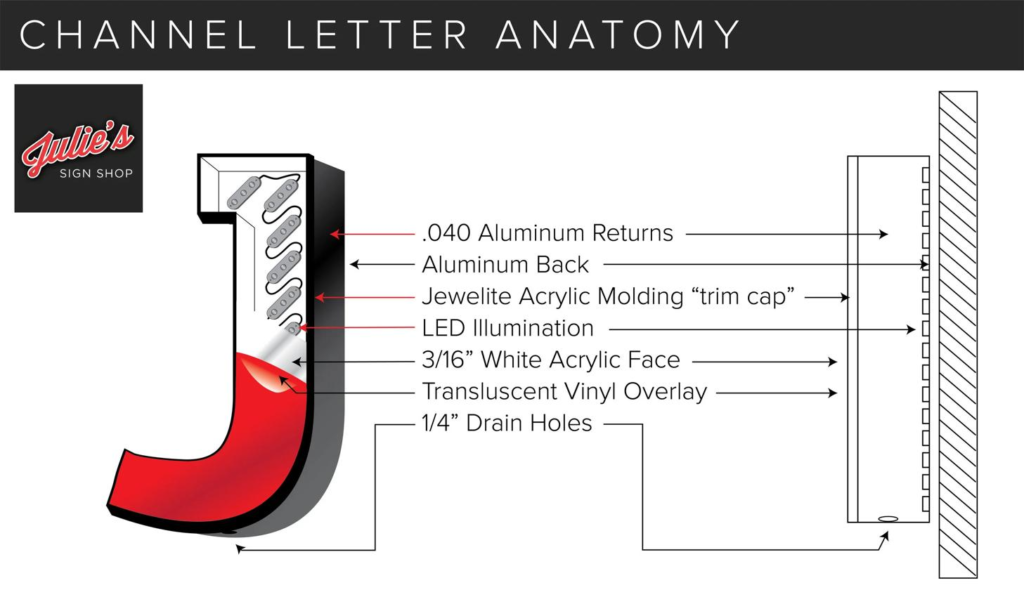
- LED channel letters
- Illuminated logos
- Light box faces
- Interior branding signs
If your project requires a premium illuminated effect, our [custom LED channel letters manufacturing guide] explains how acrylic faces, LED modules, and letter structures work together to create professional storefront lighting.
Why Acrylic Is Still the Standard for LED Signs
High-quality acrylic provides:
- Excellent optical clarity
- Smooth light diffusion
- Stable appearance
- Wide color selection
- Easy fabrication
Professional acrylic manufacturers such as ACRYLITE official acrylic technology resources develop acrylic specifically for lighting and signage applications, including illuminated letters and display systems.
Cast Acrylic vs Extruded Acrylic
Not all acrylic performs the same.
Cast Acrylic
Advantages:
- Higher molecular consistency
- Better machining performance
- More stable outdoor appearance
- Better resistance to environmental stress
Extruded Acrylic
Advantages:
- Lower production cost
- Consistent thickness
For premium commercial signage, cast acrylic is generally preferred because appearance and long-term stability are more predictable.
Acrylic Outdoor Limitations
Acrylic is excellent for illuminated letters but should not be considered a universal outdoor panel material.
It is best used as:
✔ LED letter faces
✔ Light diffusing panels
It is less suitable for:
✘ Large unsupported outdoor sheets
✘ High-impact areas
For oversized illuminated letters, some manufacturers consider polycarbonate because of its higher impact resistance.
PVC: A Budget Material With Limited Outdoor Applications
PVC remains popular because it is:
- Affordable
- Easy to cut
- Lightweight
- Simple to print
However, PVC is mainly an indoor and temporary signage material.
Typical applications include:
- Promotional signs
- Event displays
- Indoor logo boards
- Temporary advertising
For permanent outdoor storefront signs, PVC often becomes a false economy because replacement costs can exceed initial savings.
Polycarbonate: The Professional Alternative for Large Illuminated Letters
Although not always included in basic material comparisons, polycarbonate deserves attention.
Its biggest advantage:
Exceptional impact resistance.
Compared with acrylic:
- Much stronger against impact
- Better for oversized illuminated letters
- Suitable for demanding environments
However:
- It requires UV protection
- It scratches more easily
- Material cost is higher
A practical guideline:
Under 3 feet letter height:
→ Acrylic is usually sufficient
Over 3 feet letter height:
→ Polycarbonate may provide better safety
Material Comparison for Different Storefront Sign Applications
Scenario 1: Permanent Storefront Sign (5+ Years)
Recommended:
ACM or Aluminum
Choose ACM for:
- Large flat signs
- Retail storefront panels
- Cost-efficient projects
Choose aluminum for:
- High wind locations
- Structural applications
Scenario 2: Illuminated Channel Letters
Recommended:
Acrylic
Because:
- Excellent light diffusion
- Premium appearance
- Easy LED integration
For oversized letters:
Consider polycarbonate.
Scenario 3: Large Building Wall Branding
Recommended:
ACM
Advantages:
- Lightweight
- Flat surface
- Easy CNC processing
- Efficient installation
Scenario 4: Temporary Advertising Signs
Recommended:
PVC
Best for:
- Events
- Promotions
- Short-term campaigns
Scenario 5: High Wind or Impact Areas
Recommended:
Aluminum
Because:
- Strong structure
- Better resistance
- Long-term reliability
Outdoor Sign Material Decision Matrix
Instead of choosing materials only by price, evaluate three factors:
1. Expected Lifespan
Less than 2 years:
→ PVC
3–7 years:
→ ACM
8+ years:
→ Aluminum or premium ACM
2. Environmental Requirements
Need lighting?
→ Acrylic / Polycarbonate
Need structural strength?
→ Aluminum
Need large flat panels?
→ ACM
Need custom 3D shapes?
→ Aluminum fabrication or CNC-cut ACM
3. Budget Consideration
For large flat signage:
ACM usually provides the best balance between:
- Cost
- Weight
- Appearance
- Installation efficiency
However, when structural performance is required, aluminum is not an unnecessary upgrade — it is a long-term investment.
Final Answer: Which Material Should You Choose?
There is no universal winner.
The correct material depends on the environment.
For a storefront sign installed outdoors, wider than 4 feet, without heavy impact risk:
ACM is usually the smartest choice.
For signs exposed to:
- Strong wind
- Heavy impact
- Structural stress
Aluminum is the safer investment.
For illuminated letters:
Acrylic remains the industry standard because of its superior lighting performance.
For temporary signage:
PVC is acceptable, but only when short service life is expected.
Need Help Selecting the Right Storefront Sign Material?
Choosing the right material is one of the most important decisions in a custom signage project.
HLW Sign provides professional recommendations for:
- [Custom Storefront Signs]
- [LED Channel Letters]
- [Metal Logo Signs]
- [Commercial Architectural Signage Solutions]
Our team helps customers select the right combination of aluminum, ACM, acrylic, stainless steel, and LED systems based on:
- Installation location
- Weather conditions
- Expected lifespan
- Project budget
Contact HLW Sign for a free material evaluation and custom signage recommendation.