
Ordering a custom sign should not begin with only one question: “How much does it cost?”
A reliable custom signage quote depends on much more than the appearance of a logo. Artwork quality, overall dimensions, letter height, materials, illumination, installation method, order quantity, electrical requirements, packaging, and shipping destination can all affect the final custom sign price.
This is why two signs that look almost identical in a rendering may have very different production costs.
For business owners, sign companies, architects, franchise operators, and purchasing managers, preparing the right information before requesting a quotation can save several rounds of emails and significantly reduce the risk of specification changes later.
This guide explains what a professional sign manufacturer actually needs to calculate an accurate custom signage quote, how signage MOQ works, and which technical details have the greatest influence on your final price.
Why Is an Accurate Custom Signage Quote So Important?
Custom signage is not a standard off-the-shelf product.
Every project can involve different dimensions, materials, lighting methods, fabrication techniques, mounting systems, electrical components, packaging requirements, and installation environments.
For example, a 2-meter-wide indoor acrylic logo and a 2-meter-wide outdoor illuminated stainless-steel logo may have the same overall dimensions, but their structures are completely different.
The outdoor version may require thicker metal, waterproof LEDs, sealed wiring, drainage design, stronger mounting hardware, outdoor-rated power supplies, more protective packaging, and additional testing.
Therefore, a realistic custom sign price can only be calculated after the manufacturer understands how the sign will actually be made and installed.
If you receive a quotation based only on a JPG logo and the words “about 2 meters wide,” the price should usually be considered preliminary rather than final.
1. Start With the Right Artwork Files
The first thing a sign factory needs is your artwork.
Whenever possible, send a vector file such as:
| Preferred File | Suitable for Production? | Notes |
|---|---|---|
| AI | Excellent | Preferred for Adobe Illustrator artwork |
| EPS | Excellent | Common vector format |
| SVG | Excellent | Useful for logos and web-based artwork |
| Vector PDF | Excellent | Convenient for international projects |
| CDR | Good | Common in signage production |
| High-resolution PNG | Usable | May require vector tracing |
| JPG / screenshot | Preliminary only | Usually needs redrawing |
Vector artwork allows the manufacturer to measure every letter, curve, stroke, spacing, and logo element accurately.
This matters because very narrow strokes can change the recommended construction method. A logo may look easy to reproduce on a computer screen but become difficult to manufacture as illuminated dimensional letters when the smallest stroke is only a few millimeters wide.
If you do not have a vector file, a professional factory can often redraw the logo before production.
At HLW Sign, customers can send AI, EPS, SVG, PDF, CDR, PNG, or even a clear reference image. Our team can review the artwork and recommend a production-ready structure.
For additional examples of what information manufacturers need before production, see HLW Sign’s guide to Backlit Channel Letters.
2. Always Provide the Overall Size
Size is one of the biggest factors affecting a custom sign price.
However, “large,” “medium,” or “about the same size as the photo” is not enough.
Ideally, provide at least one confirmed dimension:
Overall width × overall height
For example:
2000 mm W × 450 mm H
If your logo proportions are fixed, the manufacturer can normally calculate the second dimension automatically once either width or height is confirmed.
Letter height is also useful, especially for channel letters.
Suppose you request:
HAIR & BEAUTY — total width 2000 mm
Depending on the font, the actual capital-letter height might be approximately 180–220 mm. Changing to a wider or narrower font can significantly change the letter height while keeping the same overall width.
This is why the artwork should be scaled before the quotation is finalized.
For large building signs, also provide the available installation area. A photo of the storefront with one known measurement is extremely useful.
3. Material Selection Has a Major Effect on Custom Sign Price
The phrase “3D letters” describes the shape of a product, not its material.
A three-dimensional sign could be manufactured from stainless steel, aluminum, galvanized steel, acrylic, resin, ACP, or combinations of several materials.
Stainless Steel
Stainless steel is widely used for premium architectural letters and illuminated logos.
Common options include:
304 stainless steel for general commercial applications, 316 stainless steel for coastal or high-salt environments, brushed stainless steel for a refined matte appearance, mirror stainless steel for highly reflective finishes, and titanium-coated gold or rose-gold finishes for luxury projects.
Aluminum
Aluminum is lighter than stainless steel and is especially useful for large outdoor letters, raceways, cabinets, and projects where overall weight needs to be controlled.
Acrylic
Acrylic is commonly used for illuminated sign faces because it diffuses LED light effectively.
Typical applications include front-lit channel letters, illuminated logo faces, acrylic light boxes, push-through lettering, and decorative indoor signs.
If you are comparing illuminated structures, HLW Sign’s Front-Lit Channel Letters vs. RGB Letter Signs guide explains how different lighting systems affect construction and cost.
Material is therefore one of the first specifications that should be confirmed when requesting a custom signage quote.
4. Specify Whether the Sign Is Illuminated
Illumination can significantly change both construction and cost.
A quotation should identify whether your sign is:
Front-lit, backlit or halo-lit, front and back illuminated, edge-lit, internally illuminated as a light box, single-color LED, RGB, RGBW, RGB+CCT, or non-illuminated.
A brushed stainless-steel letter with no lighting is structurally much simpler than the same letter with 3200K halo illumination.
The illuminated version may require LED modules, acrylic backing, a stand-off mounting system, power supplies, wiring, waterproof connections, and additional assembly and testing.
For RGB or programmable signage, controllers and additional wiring can also increase the custom sign price.
If you are considering color-changing illumination, see the HLW Sign guide to Acrylic RGB Signs.
5. Tell the Factory Where the Sign Will Be Installed
Indoor and outdoor signage should not automatically use the same construction.
Before requesting a custom signage quote, tell the manufacturer whether the project is for:
an indoor reception wall, shopping mall, storefront façade, rooftop, exterior building wall, roadside pylon, restaurant interior, hotel lobby, coastal location, or fully exposed outdoor environment.
An outdoor sign may require additional weather resistance, corrosion resistance, sealing, drainage, structural reinforcement, and waterproof electrical components.
Installation photos are particularly useful for halo-lit signs because wall color and wall texture can affect the appearance of the rear illumination.
A smooth dark wall produces a different halo effect from rough brick, stone, or highly reflective cladding.
HLW Sign discusses these design factors in its Backlit Channel Letters buying guide.
6. Installation Method Can Change the Price
A sign cannot be accurately quoted without considering how it will be installed.
Common installation options include individual stud mounting, threaded rods, spacer mounting for halo illumination, raceway mounting, backboard mounting, hanging installation, structural brackets, freestanding frames, and pylon structures.
Individual channel letters usually require more installation positioning than a complete logo mounted on one backboard.
A raceway may increase factory material cost but can reduce installation complexity because electrical connections can be preassembled inside one structure.
When possible, send a clear photo of the installation wall and tell the supplier whether the surface is concrete, brick, metal cladding, wood, glass, drywall, stone, ACP, or another material.
7. What Does Signage MOQ Mean?
Signage MOQ means the minimum order quantity a manufacturer is willing to produce.
Unlike mass-produced consumer goods, custom signs are usually project-based.
A factory may need to create drawings, laser-cut unique components, bend custom letter returns, prepare LED layouts, assemble wiring, test the sign, and build project-specific packaging even for a single logo.
For this reason, signage MOQ works differently from the MOQ for standard products such as screws, LED bulbs, or printed packaging.
At HLW Sign, many customized signage products can start from an MOQ of one custom set, which makes the factory suitable for individual stores, architects, designers, contractors, and first-time buyers as well as larger commercial projects.
However, larger quantities generally create better production efficiency.
If ten stores use the same logo construction, material, LED specification, and finish, setup costs can be distributed across multiple sets. This can reduce the unit custom sign price.
Therefore, when requesting a quotation for a franchise or multi-location project, provide the expected total quantity even if the first order will only be one sample location.
8. Electrical Requirements Should Be Confirmed Before Production
For illuminated signage, specify the installation country.
The factory needs this information to determine suitable input voltage, plug configuration, power supply, controller, wiring, and other electrical requirements.
For U.S. electric signage projects, buyers and installers may need to consider requirements including NEC Article 600 and UL 48 depending on the project and jurisdiction. The International Sign Association provides information on electric-sign codes and standards.
You can review the professional reference here: International Sign Association — Technical Codes & Standards.
For European projects, relevant EU requirements should be reviewed based on the exact product configuration. CE marking is not simply a generic “certificate”; manufacturers and importers need to identify which applicable EU legislation applies to the product.
Official reference: European Commission — CE Marking.
9. Shipping Destination Is Part of an Accurate Quote
A sign quotation and a delivered quotation are not always the same thing.
For international projects, provide at least:
destination country, city or postal code, required delivery method, target arrival date, and preferred trade term if known.
Large dimensional letters may have a relatively low product weight but occupy significant shipping volume.
Packaging design therefore affects the landed custom sign price.
For overseas orders, HLW Sign uses export-oriented protective packaging according to the sign structure. Finished products can be photographed or recorded before shipment, and fragile acrylic faces, metal finishes, LEDs, controllers, and power supplies can be separately protected where necessary.
This export experience is especially important for customized signage because replacing a damaged one-off logo is much more complicated than replacing a standard product.
10. What Information Should You Send to Get a Fast Custom Signage Quote?
A professional quotation request does not need to be complicated.
For the fastest and most accurate response, send the manufacturer your artwork, overall dimensions, quantity, preferred material or finish, illumination method, installation location, indoor or outdoor use, wall or mounting information, destination country/postal code, and required delivery date.
If you do not know the correct material or construction, that is completely normal.
Instead of guessing, explain the visual result you want and provide reference images.
An experienced manufacturer should be able to recommend a practical structure based on appearance, size, installation environment, durability, and budget.
How HLW Sign Calculates a Custom Sign Price
HLW Sign is a factory-direct custom signage manufacturer established in 2010.
The factory is located in China Chengnan Signage Industrial Park, within an established signage manufacturing supply-chain cluster, and operates approximately 3,250 square meters of manufacturing space.
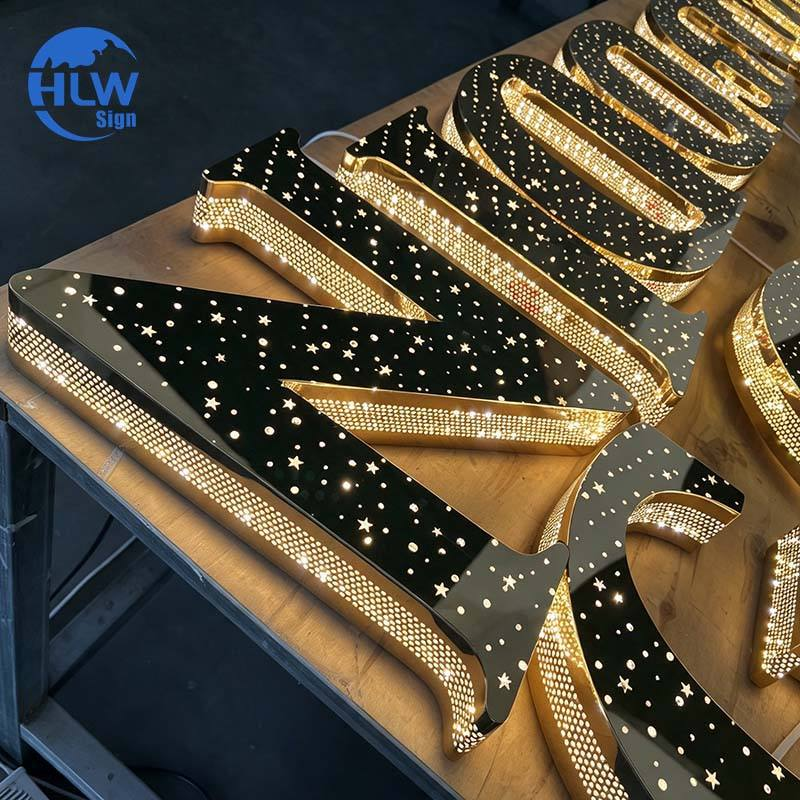
HLW Sign produces a wide variety of custom signage, including front-lit channel letters, backlit letters, illuminated logos, stainless-steel letters, acrylic signs, light boxes, RGB and RGBW signs, LED neon signs, perforated letters, directional signs, pylon signs, and other custom architectural signage.
Explore more products and manufacturing capabilities at HLW Sign — Custom LED Sign Manufacturer.
Instead of applying one standard price to every project, our team reviews the artwork, dimensions, materials, structure, lighting, quantity, installation method, electrical configuration, packaging, and destination before calculating the final custom signage quote.
This factory-direct model helps reduce unnecessary trading layers while allowing production details to be discussed directly with the manufacturing team.
HLW Sign has more than 15 years of signage production experience and has supplied signage to customers in more than 50 countries. The factory also provides pre-shipment testing, production photos or videos, export packaging, and after-sales support.
For eligible LED signage products, HLW Sign provides a three-year LED quality warranty, with the exact warranty coverage confirmed according to the final product specification and quotation.
Why the Cheapest Custom Sign Price Is Not Always the Best Quote
When comparing quotations, make sure you are comparing the same specification.
One supplier may quote 201 stainless steel while another uses 304 stainless steel.
One quotation may include branded waterproof LED modules while another uses an unspecified LED strip.
One supplier may include the power supply, controller, installation template, hardware, and export crate while another may list these separately.
As a result, a lower custom sign price does not necessarily mean the same product costs less.
Before making a purchasing decision, compare the complete specification.
HLW Sign has also prepared a detailed guide explaining What Affects LED Sign Price.
Frequently Asked Questions
What files are best for a custom signage quote?
AI, EPS, SVG, CDR, and vector PDF files are preferred. A high-resolution PNG or JPG can also be used for preliminary evaluation, but the artwork may need to be redrawn before production.
Can I get a quote if I only have a logo image?
Yes. Send the clearest image available together with your target dimensions. HLW Sign can review whether the artwork needs vectorization before production.
What is the typical signage MOQ?
For many customized HLW Sign products, signage MOQ can start from one set. Larger repeated orders can usually achieve better per-unit production efficiency.
What affects the custom sign price the most?
The main factors are size, material, construction, illumination, design complexity, quantity, installation method, electrical components, packaging, and shipping destination.
Do larger signs always cost more?
Usually, but not proportionally. A sign twice as wide does not automatically cost exactly twice as much because manufacturing setup, LED density, structural design, packaging, and shipping volume all affect the calculation.
Can HLW Sign recommend materials if I am unsure?
Yes. Send your logo, target size, installation photo, indoor or outdoor environment, desired lighting effect, and budget range. The factory can recommend an appropriate construction.
Can I order only one custom sign?
Yes. Many projects can be produced from one custom set, making HLW Sign suitable for both individual projects and large commercial rollouts.
Get an Accurate Custom Signage Quote from HLW Sign
The fastest way to receive an accurate custom signage quote is to provide clear artwork, confirmed dimensions, installation information, material preferences, quantity, and destination details from the beginning.
If some specifications are still uncertain, send your logo and reference images first.
HLW Sign can help convert your design into a production-ready solution, recommend suitable materials and lighting, confirm signage MOQ, calculate the custom sign price, prepare drawings before production, test the finished signage, and arrange protective export packaging for international delivery.
Whether you need one reception logo, a storefront channel-letter set, a large illuminated building sign, an RGB logo, a light box, or signage for multiple franchise locations, HLW Sign provides factory-direct custom manufacturing from design review through production and export.
Send your artwork, size, quantity, installation photo, and delivery destination to HLW Sign today to receive a customized quotation.