
Quick answer: 8K mirror stainless looks brighter and more luxurious but shows fingerprints and cannot take a reliable nano coating. Brushed stainless accepts nano anti-fingerprint coating, hides marks and is easier to clean, so it is the better choice for outdoor and high-traffic signs.
Two backlit letters can leave the factory with the same LED modules, the same acrylic diffuser and the same halo effect, yet look completely different on a wall. The difference is the metal face: an 8K mirror stainless steel surface or a brushed stainless steel surface. One reflects the room like a mirror; the other absorbs light and hides handling marks.
This guide compares the two finishes on the points that actually decide a project: brightness, fingerprint resistance, coating options, welding and polishing, electroplating colours, cleaning cost and the environments where each one wins.
Quick comparison: mirror vs brushed backlit letters
| Item | 8K mirror stainless | Brushed stainless |
|---|---|---|
| Surface | Mirror-polished, 8K equivalent | Directional satin grain |
| Reflectance | Very high, mirror-like | Diffuse, soft sheen |
| Fingerprints | Shows every touch | Hidden by grain plus nano coating |
| Nano anti-fingerprint coating | Not recommended | Yes, standard option |
| Scratch visibility | High | Low |
| Cleaning frequency | Daily in retail | Weekly or monthly |
| Electroplating | Yes | Yes |
| Best location | Indoor premium interiors | Outdoor and high-traffic areas |
What “8K mirror” actually means
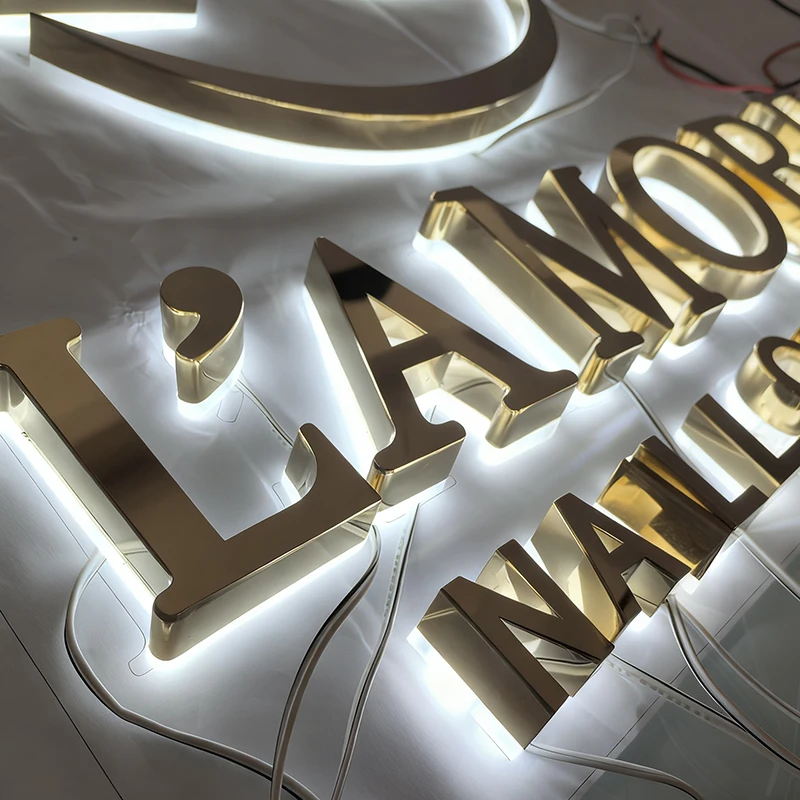
8K is a polishing grade, not a steel grade. The stainless steel is sanded and buffed through progressively finer abrasives until the surface reaches a mirror finish roughly equivalent to an 8000-grit polish. The result is a surface with very low haze: a logo edge looks sharp, a gold or black titanium plating looks deep, and the letter reflects the surrounding interior.
On a custom backlit logo sign, that reflection is the point. The face reads as jewellery rather than signage, which is why mirror finish is common in hotel lobbies, watch boutiques and cosmetics counters.
Advantages of mirror backlit letters
- Highest visual brightness. After welding, grinding and final polishing, the surface reflects more ambient light, so the letter reads brighter even before the LEDs are switched on.
- Premium perception. Mirror edges and a crisp halo make a brand look expensive; this is the finish most often requested for luxury retail.
- Strong colour under plating. Gold, rose gold, champagne and black titanium plating look richer on a polished substrate than on a grained one.
- Sharp logo geometry. Fine strokes and small counters stay clean because the surface does not scatter light.
Disadvantages of mirror backlit letters
- Fingerprints are unavoidable. Every installer’s glove, cleaner’s cloth and customer’s hand leaves a mark that is visible from two metres away.
- Nano anti-fingerprint coating cannot be applied reliably. The coating needs a micro-textured surface to bond; on a mirror surface it either pools, hazes the reflection, or wears off unevenly, which looks worse than no coating.
- Scratches show. A single wipe with a dry cloth can leave micro-scratches that catch the light.
- Welding is less forgiving. Every weld seam has to be ground and re-polished to match the surrounding mirror; a rushed job shows as a dull patch.
- Higher maintenance cost. Retail staff end up cleaning the letters daily, and cleaning labour is often more expensive than the finish itself.
Brushed stainless backlit letters: the practical finish
Brushed stainless uses a controlled abrasive grain in one direction, usually horizontal or vertical, so the surface scatters light instead of reflecting it. That scattering is what hides fingerprints, dust and fine scratches.
Because the surface has a fine texture, it accepts a nano anti-fingerprint coating. The coating fills the micro-grooves and lowers surface energy, so fingerprints do not bond and cleaning becomes a wipe rather than a polish.

Advantages of brushed backlit letters
- Nano anti-fingerprint coating works. This is the main practical difference: brushed letters stay clean-looking in busy entrances.
- More dirt-resistant and easier to clean. Dust and water spots are less visible, and a damp microfibre cloth restores the surface without polishing compound.
- Hides scratches and handling marks. Installation wear does not become a permanent feature of the sign.
- Better for outdoor and coastal projects. The diffuse surface is less sensitive to salt haze and pollution films; with 316 stainless it is the safer choice for marine environments.
- Lower lifetime cleaning cost. For multi-site retail and property management, this usually outweighs the slightly lower gloss.
Disadvantages of brushed backlit letters
- Less mirror-like. Brushed letters look refined but not jewel-like; they will not reflect the interior.
- Grain direction must be consistent. If two letters are brushed in different directions, the set looks mismatched under grazing light.
- Welds must be re-grained. After welding and polishing, the grain has to be restored across the seam, otherwise a shiny patch appears.
- Plating looks softer. Gold and black titanium read as satin rather than high-gloss, which is a design choice, not a defect.
Welding and polishing: where the quality difference shows
Both finishes depend on the weld quality underneath. For mirror letters, the sequence is TIG welding, seam grinding, progressive sanding and final mirror polishing. Any pinhole or undercut returns as a dark line in the reflection. For brushed letters, the sequence is TIG welding, seam grinding, then re-brushing the whole face in one direction so the grain runs continuously across the joint.
This is why two suppliers can quote the same “8K mirror” and deliver very different products. Ask for close-up photos of the weld seam under raking light before production, not after.
Electroplating and colour options
Both surfaces can be electroplated. Common finishes are gold, rose gold, champagne gold, black titanium, gunmetal and bronze, all selected from a physical colour card. The substrate changes the result: plating over mirror gives a deep, reflective colour; plating over brushed gives a softer satin metallic look.
If the project needs an exact brand colour, request a plated sample coupon rather than choosing from a screen. Lighting temperature, surrounding materials and the halo glow all shift how the plating reads in place.
Backlighting: the part that is the same on both
The finish does not change the light engine. A quality front lit vs backlit channel letters comparison still applies: backlit letters throw light onto the wall, so standoff distance, LED pitch and wall colour matter more than the metal face.
- Use a uniform diffuser so the halo has no hot spots; the acrylic face for backlit letters decides diffusion and UV stability.
- For colour-changing versions, confirm the controller and module type in the RGB backlit letters guide before fixing the power layout.
- Outdoor installations need a sealed light engine and drainage; see IP65 backlit letters for outdoor use.
- Surface treatment and paint durability are covered in the stainless steel for backlit letters material comparison and the finish durability for backlit letters article.
Which finish suits which location
Choose 8K mirror when
- The sign is indoors, above hand height, and cleaned by trained staff: hotel lobby, jewellery store, watch boutique, cosmetics counter, private clinic reception.
- The brand language is luxury and the halo is part of the interior design.
- The logo has fine strokes that benefit from a sharp reflective edge.
- You accept a daily wipe-down routine, or the letters are mounted out of reach.
Choose brushed stainless when
- The sign is outdoors, at street level, or in a high-traffic mall entrance where people touch it.
- The site is coastal or industrial; combine brushed 316 with the maintaining 316 stainless backlit letters routine and the coastal backlit letter specification checklist.
- Cleaning is done by a facilities contractor on a weekly cycle, not by brand staff daily.
- The design is architectural or industrial and a satin sheen fits better than a mirror.
For a mixed portfolio, a common approach is mirror for interior reception logos and brushed for exterior and wayfinding letters, keeping the same plating colour so the brand still reads as one system. Browse the full range of backlit channel letters to see both finishes side by side.
Cleaning and maintenance
Mirror letters: use a clean microfibre cloth with a pH-neutral glass cleaner, wipe in one direction, and never use dry paper towels or abrasive cream. Accept that the finish will show handling; schedule cleaning before opening hours.
Brushed letters with nano coating: wipe with a damp microfibre cloth, dry with a second cloth, and avoid silicone polishes that build a film. The coating is not permanent; plan to refresh it every two to three years in outdoor locations.
For either finish, check the light engine separately from the metal. Halo shadows usually come from LED pitch or standoff distance, not from the surface.
Cost and lead time
Mirror letters carry more labour: seam polishing takes longer, rework rates are higher, and packing needs protective film on every face. Brushed letters are faster to finish because the grain can be restored across a weld in one pass. On a typical project the material cost is similar; the difference sits in polishing hours and in the replacement cost of a scratched mirror letter.
If the budget is tight and the sign is at street level, brushed is almost always the better value. If the sign is the centrepiece of a premium interior, mirror is worth the maintenance.
Specification checklist
- Stainless grade: 304 for inland, 316 for coastal or chemical exposure.
- Finish: 8K mirror or brushed, with grain direction stated on the drawing.
- Coating: nano anti-fingerprint on brushed only; state it explicitly on the PO.
- Plating colour: physical colour card reference, plus a sample coupon for brand colours.
- Light engine: LED pitch, colour temperature, IP rating and driver location.
- Mounting: standoff distance, template, and drainage if outdoors.
- Packing: mirror faces need peel-off film and foam; ask for the packing photo before shipment.
FAQ
Can mirror stainless be given an anti-fingerprint coating?
It can be attempted, but the result is unreliable. The coating needs a textured surface to anchor; on a mirror it tends to haze the reflection or wear unevenly. For a sign that people will touch, brushed is the honest choice.
Is brushed stainless less bright?
The metal reflects less ambient light, but the backlit halo is produced by the LEDs and diffuser, not the face. At night the difference is small; in daylight the mirror version looks brighter.
Can both finishes be electroplated in the same colour?
Yes. Both accept gold, rose gold, champagne, black titanium and bronze plating from the same colour card. The substrate changes the gloss level, not the colour family.
Which one lasts longer outdoors?
Both can last years if the grade and sealing are correct, but brushed 316 is more forgiving. It hides salt haze, resists visible scratching and is easier to clean, which matters more than the initial gloss.
Next step
Send us the logo file, the mounting wall photo and the lighting condition. We will recommend mirror or brushed based on where the sign sits and who will clean it, then quote both options with the same light engine so the comparison is fair. See the backlit logo sign reference page for finish samples and past projects.
Further reading on materials and standards: stainless steel grades and families, Nickel Institute guidance on stainless steel, IEC 60529 IP ratings, US Department of Energy on LED lighting, and ASTM B117 salt spray testing.