


Two illuminated signs can use the same stainless steel return, the same acrylic face and the same LED modules, yet look completely different from the street. The deciding detail is usually the edge: does a stainless steel frame wrap the face, or does the acrylic run cleanly to the edge with no visible cap?
Both styles are front-lit channel letters. The difference is construction and appearance, not whether the sign lights up. This guide compares trimless vs trimmed channel letters on edge protection, weather sealing, maintenance, fabrication and application, so you can specify the right one for a storefront, reception wall, rooftop or coastal project.
What Is a Trimmed Stainless Steel Channel Letter?
A trimmed letter has a stainless steel frame, often called a trim cap or return, that wraps the edge of the acrylic face. The frame creates a visible outline and protects the acrylic edge. HLW’s face-lit specification uses a 3–5 mm acrylic face and a 0.5–0.8 mm stainless steel side frame, with frame heights of 5 cm for 20–40 cm letters, 6 cm for 40–60 cm, 6–8 cm for 60–70 cm and 8–10 cm above 70 cm. This front-lit LED letter option uses LEDs inside the return, shining through the acrylic face.
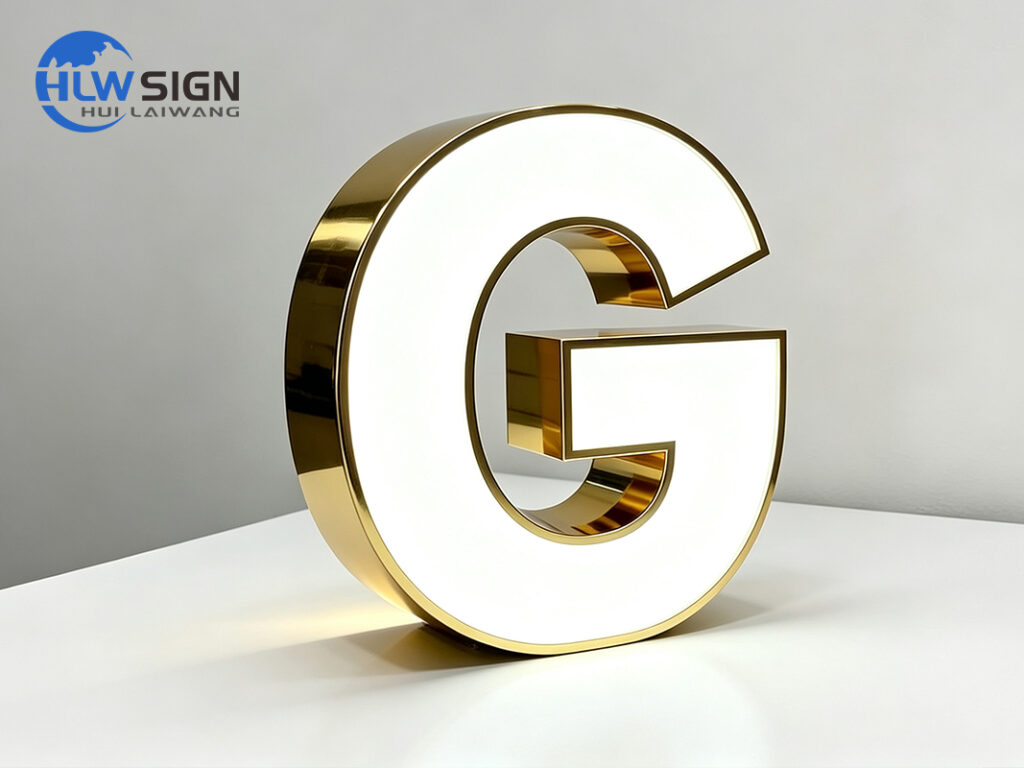
The frame is not only decorative. It adds stiffness to the letter, hides the joint between the face and the return, and gives the sign a crisp, finished edge. That is why trimmed letters are common on large exterior signs, where wind load and edge impact are part of everyday service.
What Is a Trimless Channel Letter?
Trimless channel letters remove the visible cap. The acrylic face is fitted directly to the metal return, so the illuminated face runs to the edge and there is no stainless border framing the letter. HLW’s trimless specification uses a 5–15 mm acrylic face, LED strips or modules, and galvanized steel, stainless steel or aluminum returns. The thicker acrylic is not cosmetic: it gives the edge rigidity and a clean finish without a cap.

The result is a quieter, more architectural look. The face reads as one continuous luminous surface, which suits logos, script lettering, reception walls and modern facades where the sign should feel built into the space. These channel letters still need a precisely made return and a reliable face-to-return seal; removing the frame does not remove the engineering.
Trimless Face-Lit and LED Channel Letters: What Buyers Mean
Buyers often search for “trimless face-lit channel letters”, “trimless front-lit channel letters” or “trimless LED channel letters”. In practice, these terms usually describe the same construction: a front-lit acrylic face fitted directly to the return, with no visible trim cap. “Face-lit” describes where the light exits; “LED” describes the light source. The letter body, return depth and sealing detail still need to be specified.
Trimmed vs Trimless: Side-by-Side Comparison
| Consideration | Trimmed stainless steel letters | Trimless letters |
|---|---|---|
| Visible edge | Stainless steel frame around the face | Acrylic face runs to the edge |
| Edge protection | High: the frame shields the acrylic edge | Depends on acrylic thickness, bonding and sealing |
| Structural stiffness | Frame adds stiffness; useful on large letters | Thicker acrylic and return engineering carry the load |
| Appearance | Classic, defined outline; metal border is part of the design | Seamless, minimal, architectural |
| Weather sealing | Frame helps shield the face edge; sealing still critical | Relies on the face-to-return joint and sealant detail |
| Acrylic thickness (HLW spec) | 3–5 mm | 5–15 mm |
| Fabrication focus | Frame fabrication, fit and assembly | Precision edge finishing and bonding |
| Maintenance | Frame can be cleaned and polished; edge is protected | Clean carefully; edge chips are harder to repair |
| Typical best use | Large outdoor signs, rooftops, industrial and commercial facades | Premium retail, hotels, showrooms, interiors and modern facades |
Where Trimmed Letters Work Best
Trimmed letters are the safer choice when the sign has to take physical punishment. The stainless frame protects the acrylic edge during transport, installation and cleaning, and it adds a structural lip that helps large letters keep their shape. On a long store front sign exposed to wind-driven rain, the frame also gives the installer a predictable edge to seal and fasten.
Typical applications include large exterior storefront signs, rooftop letters, commercial building facades, industrial parks, gas stations and projects where a crisp metal outline fits the brand. For coastal sites, specify 316 stainless steel rather than 304 and confirm the finish, fixings and sealing method. The frame helps with edge protection, but it does not replace correct grade selection.
Trimmed letters also suit retrofits. When an existing sign has a visible metal border, matching that detail can keep the facade consistent. The trade-off is visual: the frame is always part of the composition, so it must match the brand rather than fight it.
Where Trimless Letters Work Best
Trimless letters are usually chosen for appearance first. With no cap around the face, the letter reads as a clean luminous shape. That works especially well for script logos, thin strokes, reception walls and interior brand features where a metal border would add visual noise.
Typical applications include premium retail, hotel lobbies, showrooms, shopping malls, restaurants, corporate reception areas, exhibition displays and modern building facades. For outdoor use, the specification has to be more careful: thicker acrylic, a precise face-to-return joint, sealed wiring, drainage and outdoor-rated power supplies. A trimless sign can perform well outdoors, but it depends on fabrication quality rather than a protective frame.
Trimless letters are less forgiving of damage. If the exposed acrylic edge chips, the repair is more visible than a scuffed stainless frame. That does not rule them out for busy locations; it means the installation should protect the edges from impact and the maintenance team should know how to clean them.
Material and Specification Checklist
The trim style is only one part of the specification. The following details decide whether either style performs:
- Stainless steel grade. 304 is common for inland projects; 316 is commonly specified for coastal or chloride-rich environments. ASTM A240 covers stainless steel plate, sheet and strip used in these applications, so ask for the grade and mill documentation rather than relying on a generic “stainless steel” label. See ASTM A240 for the material scope.
- Acrylic thickness and edge finish. HLW’s trimmed specification uses 3–5 mm acrylic; the trimless specification uses 5–15 mm. For trimless letters, the edge is visible, so polishing and consistency matter as much as thickness.
- Return depth. HLW’s production guidance is 5 cm for 20–40 cm letters, 6 cm for 40–60 cm, 6–8 cm for 60–70 cm and 8–10 cm above 70 cm. A shallow return can crowd the LEDs and make the illumination uneven.
- Stroke width and minimum size. Both styles need a minimum stroke width of about 2 cm. Standard English letters are generally at least 7 cm; script and decorative fonts are often at least 20 cm. Very small counters may need to be simplified.
- LED system. Specify color temperature, CRI, lumen maintenance and driver quality. The U.S. Department of Energy’s LED Basics explains why LED efficiency and lifetime depend on the whole system, not just the LED chip.
- Sealing and IP rating. Ask how the face-to-return joint is sealed, how water drains, and what IP rating is being offered for the assembled sign. IP ratings are defined by IEC 60529; the IEC 60529 standard explains what the digits mean. Do not assume that “outdoor” automatically means waterproof.
- Electrical safety and certification. Ask which recognized testing laboratory listed the sign assembly, power supplies and wiring, and confirm that the listing scope covers the project. Installation must follow the local electrical code; NFPA 70 (NEC) is a useful reference for wiring and disconnects, and OSHA 1910.303 summarizes general electrical installation requirements.
- Mounting and wind load. Large letters need a mounting drawing that accounts for the wall substrate, standoffs, raceway and wind load. The trim style does not replace structural design.
- Finish. Brushed and mirror stainless are common; powder-coated and electroplated finishes expand the palette. Ask for a physical sample or approved color chart before production.
Common Mistakes When Choosing Between Trimmed and Trimless
The most expensive mistake is choosing an edge style before checking the installation. A trimless letter on a large rooftop may look elegant in a rendering but need extra engineering to handle wind and service access. A trimmed letter on a small interior logo may look heavier than the brand intended.
Other common issues include using 304 stainless near the coast, specifying a frame depth that is too shallow for the LEDs, ignoring the acrylic edge finish, and leaving no access for driver replacement. It also helps to decide whether the sign is front-lit or halo-lit early. If the goal is a soft glow behind the letters rather than a lit face, a backlit sign is a different construction and should be compared on its own terms.
For reception walls and interior logos that do not need illumination, metal letters avoid the electrical and sealing requirements altogether. If the design calls for deeper dimensional branding, 3D embossed metal letters can provide the depth without a lit face.
How to Choose
Use the installation environment as the first filter, then the brand look, then the budget:
- Large exterior, rooftop or high-impact location: start with trimmed stainless steel letters and confirm the structural fixing and wind-load drawing.
- Premium interior, reception or architectural facade: start with trimless letters if the design calls for a seamless face.
- Coastal or polluted environment: specify 316 stainless steel, appropriate fixings and a sealing detail that can be inspected; do not rely on the trim style alone.
- Budget: compare the total installed cost, including fabrication, acrylic thickness, frame or edge finishing, electrical components, installation and future access. A lower unit price can disappear in site work.
- Appearance: ask for a mockup or a shop drawing at the actual letter size. Edge details that look minor on a screen become obvious on a facade.
Before production, request a drawing that shows the return depth, acrylic thickness, LED layout, face-to-return detail, sealing method, mounting points and electrical entry. That drawing is more useful than a general “trimless or trimmed” decision.
Frequently Asked Questions
Are trimless letters more expensive than trimmed letters?
They often involve more edge finishing and tighter tolerances, so the fabrication cost can be higher. The difference depends on size, acrylic thickness, finish and quantity; compare the full installed cost rather than the letter price alone.
Can trimless letters be used outdoors?
Yes, when the assembly is designed for it: sealed LEDs, outdoor-rated power supplies, a controlled face-to-return joint, drainage and correct mounting. Confirm the IP rating and sealing detail for the specific sign rather than relying on the word “outdoor”.
Which style is better for coastal areas?
The stainless grade and sealing matter more than the trim style. 316 stainless steel is commonly specified for coastal environments; either trimmed or trimless construction can work if the fixings, finish and face-to-return joint are detailed correctly.
Do both styles use LEDs?
Yes. Both are commonly front-lit LED letters. A backlit or halo-lit sign is a different construction: the light reflects off the wall behind the letters instead of shining through the face.
How thick should the acrylic be?
HLW’s face-lit specification uses 3–5 mm acrylic, while the trimless specification uses 5–15 mm. The right thickness depends on letter size, stroke width, edge finish and wind exposure; the manufacturer should confirm it on the shop drawing.
Can I mix trimmed and trimless letters in one project?
It is possible, but consistency usually matters more than variety. Mixing styles can work when one is an interior feature and the other is an exterior sign, but the edge detail, finish and color temperature should still look intentional together.
Are trimless channel letters available for wholesale projects?
Yes. For sign companies and contractors, trimless channel letters wholesale orders are produced to approved drawings; confirm minimum quantities, packaging, spare parts and lead time before placing the order.
Conclusion
Trimmed and trimless letters are not a quality ranking. They are two ways to solve the same lighting problem. Trimmed letters put a protective stainless frame around the face and suit large, exposed or high-impact signs. Trimless letters remove the frame for a seamless face and suit premium retail, hospitality, interiors and modern facades where the sign is part of the architecture.
Choose the edge style after you understand the installation, the stainless grade, the acrylic thickness, the LED system and the sealing detail. If you are planning a project, send the letter sizes, viewing distance, installation environment and artwork; HLW Sign can review the construction and prepare a custom signage proposal with a shop drawing and material specification.