
Ask five suppliers to quote the same set of channel letters and you will get five different numbers. The gap is rarely greed — it is configuration. Two signs that look identical in a rendering can differ by 40% in cost, and the difference is hidden in six lines of a specification sheet that most buyers never ask to see.
This article explains what you are actually paying for, where cheap quotes hide their savings, and how to compare quotes so that the cheapest one does not become the most expensive one two winters later.
Why two quotes for the “same” sign can differ by 40%
When a buyer says “the same sign”, they usually mean the same artwork and the same overall look. When a factory says it, they mean the same artwork, the same letter height, the same return depth, the same acrylic thickness, the same LED bin code, the same driver sizing and the same hardware.
Those two definitions are not the same thing — and the gap between them is where the 40% lives. None of it is visible in a photograph of the finished sign.
The six channel letter specs that decide the price
Put these into every request for quotation. A quote that does not state them cannot be compared with one that does.
| Spec | Budget version | Specification version | Price impact |
|---|---|---|---|
| Return depth | 60 mm | 100–150 mm | Deeper returns need more material and give more even light |
| Letter height and stroke width | Small, bold faces | Tall letters with thin strokes | Cost tracks the perimeter and face area, not the height alone |
| Face material | 2 mm acrylic | 3 mm acrylic (PMMA) | Comes back to how fast the face yellows outdoors |
| LED modules | Unbranded, mixed batches | Branded modules, consistent bin code | Colour uniformity across a sign is decided here |
| Power supply | Sized to the limit, protected location only | Sized at ~80% load, IP67 driver | This is the single most common failure point |
| Hardware and finish | Painted steel, minimal fixings | Stainless steel, standoffs, 1:1 template | Decides how it survives coastal air and how easy installation is |
What actually moves the cost of custom LED letters
Size is priced by perimeter, not height. A tall thin letter and a short wide letter can cost the same, because what the factory cuts, welds, paints and wires is the outline — not the area you see.
Font complexity costs real money. Hairline strokes, tight curves and script letterforms need more welding, more masking and more chances to get it wrong than a heavy block face. If a client’s logo is a delicate script, expect the quotation to reflect it.
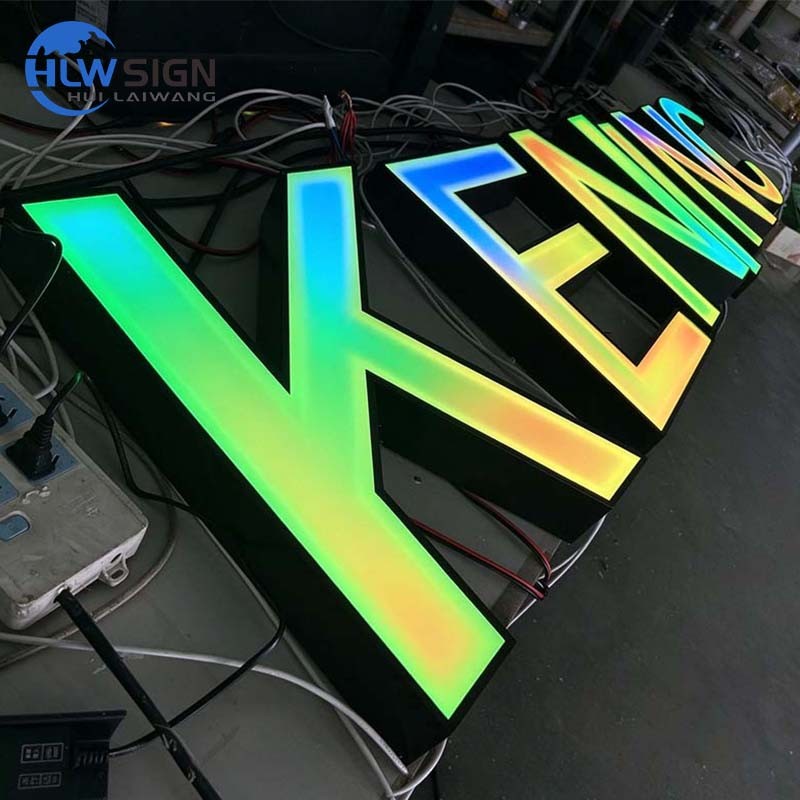
Illumination type is the second biggest lever. Front-lit letters are the baseline. Back-lit (halo) letters typically run 15–25% higher at the same letter height because the face becomes opaque and every letter needs standoffs. Side-lit and perforated letters sit in a similar bracket. RGB colour-gradient letters with controllers add another tier on top of that.
Quantity changes the maths. Setup, artwork preparation, wiring jigs and packaging are mostly fixed. Ten letters amortise them; one letter does not.
Certification has a real cost. CE and RoHS documentation is routine for a factory that exports to Europe. UL or ETL listing for the North American market is a heavier process and a genuine line item. If your market requires it, ask for it in writing at quotation stage — not after the goods are finished.
Lead time is price. A rush order means rearranging the line. Normal production for a standard order runs about 7–15 working days after artwork approval; a compressed schedule should cost more, and a supplier who absorbs it silently is cutting something else.
Where cheap quotes hide their savings
None of the following shows up in a photograph. All of them show up 18 months later:
- Face acrylic one millimetre thinner, which yellows faster under UV
- LED modules from mixed production batches, so adjacent letters differ slightly in colour temperature
- Power supplies sized at 100% of rated load with no headroom, running hot and failing first
- Mild steel hardware in coastal or humid climates
- No spare modules and no wiring diagram shipped with the order, so the first field repair costs a site visit
How the cost is actually structured
Typical split for an exterior channel letter order:
| Cost element | Share of ex-works price |
|---|---|
| Materials (metal, acrylic, paint) | 35–45% |
| LED modules and drivers | 10–20% |
| Labour, assembly, wiring, testing | 20–30% |
| Packaging (foam, carton, wooden case) | 3–5% |
| Freight, duties, last mile | Separate line — often 10–25% of landed cost |
Freight is where comparisons break down most often. Sea LCL is priced on volume, air on chargeable weight, and channel letters are mostly air. Always ask for carton dimensions and total CBM before you compare two “FOB” numbers.
Reference pricing
So that this article is actually useful, here is a real reference point from our own production line:
Stainless-steel edge, front-lit, painted finish — from USD 0.90 per centimetre of letter height, ex-works. Minimum stroke width 20 mm.
Read the qualifiers as carefully as the number, because they carry just as much weight:
- Stainless-steel edge, front-lit construction. Back-lit (halo), side-lit and perforated letters, and RGB colour-gradient work, are different constructions at different rates.
- Painted finish. Brushed, mirror-polished and other metal finishes are quoted individually.
- Per centimetre of letter height, ex-works. Packaging and freight are quoted separately, so your delivered cost depends on destination and total volume.
- Minimum stroke width 20 mm. Below that, a stainless edge with a lit face cannot be built cleanly. If your artwork has hairline strokes, we will tell you at the artwork stage rather than quietly ship a letter that looks wrong once it is switched on.
A worked example: a 600 mm tall letter in this construction is roughly USD 54 ex-works, before packaging and freight. A set of twelve, with drivers and mounting hardware, is where the real number comes from — which is why we quote from your artwork rather than from a price list.
How to compare quotes fairly
Send every supplier the same document, and ask each one to reply in the same format:
- Letter type and illumination (front-lit, back-lit, side-lit, RGB)
- Letter height, stroke width and return depth
- Face material and thickness
- LED brand, model and colour temperature
- Driver brand, load sizing and IP rating
- Fixings, templates and mounting hardware included or not
- Certification documents provided
- Spare modules and wiring diagram included
- Packaging method and total CBM
- Lead time and warranty terms in writing
Four suppliers answering that list produce a comparison you can actually make a decision with. Four suppliers sending a single number produce a lottery.
When cheap is genuinely fine
Not every job needs the premium specification, and pretending otherwise loses you orders:
- Indoor and temporary use — a photo backdrop, a trade show wall or a wedding installation runs for days, not years. A lighter spec is the right call.
- Rental stock — event rental companies care about weight and handling, not 10-year UV stability.
- Painted steel returns — perfectly reasonable inland. Questionable within a few kilometres of salt water.
The mistakes come from applying an indoor specification to a permanent exterior install — not from choosing a lighter specification deliberately.
Frequently asked questions
Are channel letters priced per letter or by size?
By size, and specifically by the outline the factory has to build. A quotation “per letter” is only meaningful when the height, stroke width and return depth are fixed.
What is a typical minimum order?
It varies by factory and by letter type. Small orders are possible, but the setup costs dominate the unit price. If you are weighing a small trial order, ask what configuration gets you the best value at that quantity.
How long does production take?
Commonly 7–15 working days after artwork approval for standard exterior letters, plus transit. Specialty and RGB work should be quoted individually because the assembly time is much higher.
Can you supply for the US market with UL/ETL?
Ask the question at quotation stage and ask for the documentation, not the promise. It changes both the price and the lead time.
What do you need to quote accurately?
Vector artwork (AI, EPS or PDF), letter height, return depth, mounting surface, quantity, destination port, and any certification requirement for the destination market.
Get a specification-level quote
Send us your artwork and destination port, and we will reply with a quote that states the letter construction, LED model, driver sizing, IP rating, packaging, CBM and lead time — line by line, so you can compare it against any other supplier without guessing what is missing.
Get a specification-level quote
Send us your artwork and destination port, and we will reply with a line-by-line quote — letter construction, LED model, driver sizing, IP rating, packaging, CBM and lead time — so you can compare it against any other supplier without guessing what is missing.
What to send us:
- Vector artwork (AI, EPS or PDF), or a clear photo of the sketch
- Letter height, stroke width, and where it will be mounted
- Quantity, plus the destination port or city
- Any certification your market requires (CE, RoHS, UL / ETL)
Fastest ways to reach us:
- WhatsApp: +8615256452807— send us a message
- Email: hlwsign@hlwsign.com
- Or fill in the form: Get a quote
We are based in China (GMT+8) and reply within 24 hours on working days.