
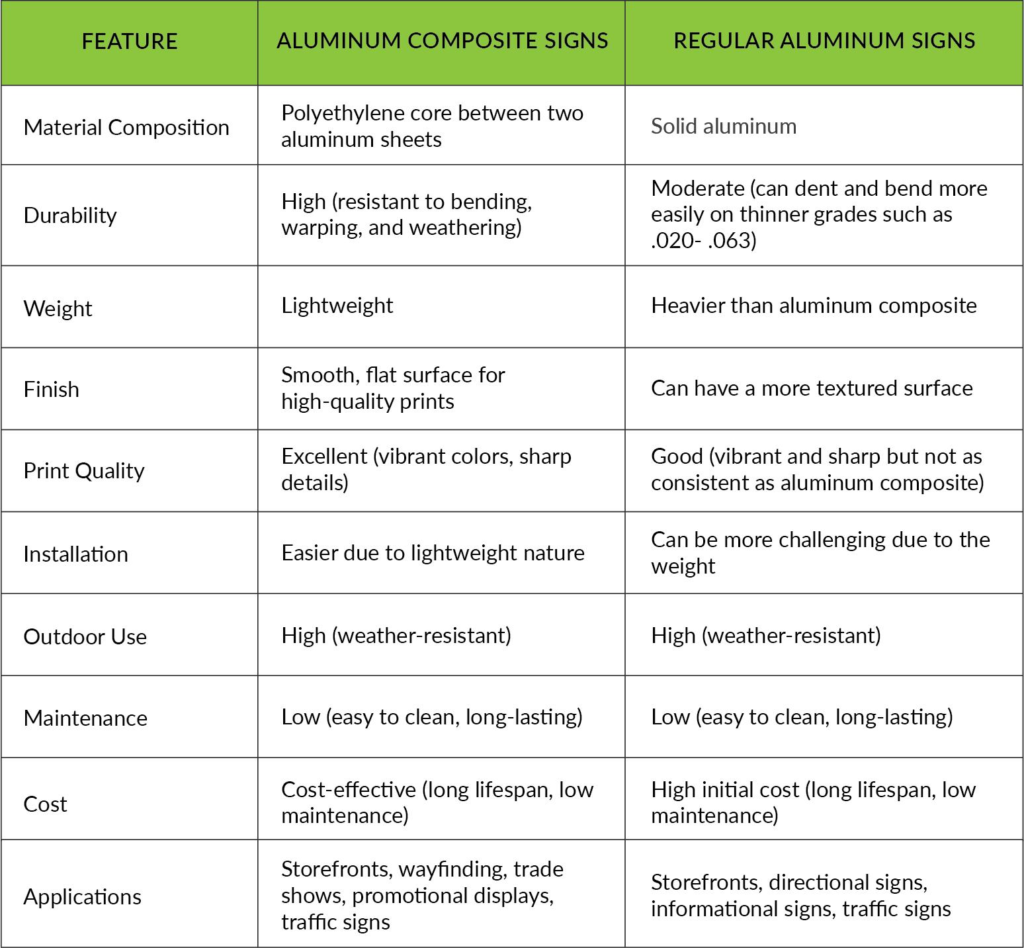
When choosing materials for a commercial storefront sign, many buyers immediately compare aluminum and ACM (Aluminum Composite Material) based only on price.
For ACM backer panels used behind custom channel letters, the panel thickness and fixing method should be confirmed before production.
This is where many signage decisions go wrong.
ACM is often misunderstood as a “cheaper alternative to aluminum.” In reality, aluminum composite panel signs have become one of the most widely used solutions for modern commercial signage because they solve a completely different problem:
How can businesses create large, flat, durable, lightweight, and visually consistent signage without unnecessary structural weight?
For architects, sign companies, contractors, and commercial brands, the real question is not:
“Is ACM better than aluminum?”
The better question is:
“Where does an aluminum composite panel sign provide the highest performance and the best return on investment?”
Compared with solid aluminum, ACM typically offers:
- Around 50% lower weight
- Excellent flatness for large panels
- Factory-finished surfaces
- Easy CNC cutting capability
- Lower installation complexity
This makes ACM an ideal material for many commercial storefront sign applications, especially when size, appearance, and installation efficiency matter.
In this guide, we will explore five high-value applications where aluminum composite panel signs provide a practical advantage.
What Makes ACM Different From Traditional Aluminum?
Before discussing applications, it is important to understand why ACM has become so popular in the signage industry.
An aluminum composite panel consists of:
- Two thin aluminum skins
- A polyethylene core
- A factory-applied surface coating
Unlike solid aluminum, ACM is engineered as a lightweight composite material.
Its advantage is not simply cost reduction.
Its real value comes from combining:
- Lightweight construction
- High surface flatness
- Consistent finishing
- Easy fabrication
According to material information from Cope Plastics ACM material guide, aluminum composite materials are available in different grades depending on aluminum skin thickness and application requirements.
For professional signage projects, choosing the correct ACM grade is critical.
A thinner panel may work for temporary displays, while commercial exterior signage often requires stronger specifications.
Application 1: Large Storefront Signs and Building Facade Branding
Large exterior walls are where ACM truly demonstrates its advantages.
For oversized storefront signs, the biggest challenges are usually not appearance — they are:
- Weight
- Installation difficulty
- Surface flatness
- Long-term maintenance
A large solid aluminum panel can become heavy and require additional structural support.
For example, a 4×8 ft aluminum sheet can weigh significantly more than an equivalent ACM panel, increasing:
- Transportation cost
- Installation labor
- Wall load requirements
This is why many commercial projects now use ACM as the primary panel material.
Why ACM Works Better for Large Flat Signs
When a sign panel exceeds several feet in width and does not need extreme impact resistance, ACM provides an excellent balance.
Advantages include:
1. Superior Flatness
Large aluminum sheets may experience visual distortion caused by thermal expansion or installation stress.
ACM maintains a cleaner, flatter appearance.
This is especially important for:
- Retail storefronts
- Corporate buildings
- Shopping centers
- Franchise locations
2. Lower Installation Cost
Because ACM panels are lightweight:
- Smaller mounting systems can be used
- Installation becomes faster
- Shipping costs are reduced
For companies managing multiple storefront locations, this efficiency creates significant savings.
You can explore more examples of commercial facade solutions through HLW Sign’s [custom storefront sign manufacturing service].
Application 2: ACM Backer Panels for LED Channel Letters
One of the most overlooked uses of ACM is as a backing panel for illuminated letters.
Many buyers focus only on the visible letters.
However, professional sign manufacturers know that the backing structure affects:
- Installation accuracy
- Final appearance
- Long-term stability
A typical LED channel letter system includes:
- Metal letter housing
- Acrylic lighting face
- LED modules
- Mounting structure
Instead of installing every letter individually onto a wall, many projects use an ACM panel.
Why ACM Is Ideal for Channel Letter Backboards
Unified Installation Surface
Individual letters installed directly onto a wall can create:
- Alignment problems
- Uneven spacing
- Difficult installation
An ACM back panel creates one consistent mounting surface.
This allows:
- Accurate spacing
- Faster installation
- Cleaner brand presentation
For customers looking for professional illuminated letter solutions, HLW Sign’s [LED channel letters manufacturing solutions] combine aluminum structures, acrylic faces, and optimized mounting systems for commercial applications.
CNC Cutting Creates More Design Possibilities
Another advantage is flexibility.
ACM can be CNC routed into:
- Custom shapes
- Brand silhouettes
- Decorative outlines
This means the back panel is no longer just a hidden component.
It can become part of the overall design language.
Application 3: Multi-Tenant Property Sign Systems
Shopping centers, office parks, and commercial complexes require signage systems that are:
- Consistent
- Replaceable
- Easy to maintain
This is where ACM panel becomes especially valuable.
A multi-tenant property may need dozens of business names displayed under one visual standard.
Using different materials for each tenant creates inconsistent appearance.
Why Property Managers Prefer ACM Sign Systems
ACM provides:
Standardized Appearance
All tenant signs can share:
- Same background color
- Same surface finish
- Same panel thickness
This creates a unified architectural style.
Easy Replacement
When tenants change:
The property manager can replace the individual panel without rebuilding the entire structure.
This reduces:
- Maintenance cost
- Installation time
- Building damage
For commercial property developers, this is one of the biggest advantages of ACM.
Application 4: Historical Building Renovation and Modern Storefront Upgrades
Renovating older buildings creates a unique challenge:
How can designers preserve historical character while introducing modern branding?
Traditional materials may look authentic but lack:
- Precision
- Lightweight installation
- Color consistency
ACM provides a modern solution.
Why ACM Works in Historic Renovation Projects
Modern ACM finishes can imitate:
- Brushed metal
- Matte black
- Custom colors
- Architectural textures
This allows designers to achieve a balance:
Respect the building’s history without creating a fake historical appearance.
Industry publications such as Signs of the Times signage industry resources have highlighted projects where ACM fabrication techniques were adapted to achieve cleaner edges and more refined architectural finishes.
Advanced Fabrication Matters
For premium renovation projects, basic ACM cutting is not enough.
Professional fabrication may include:
- Routed edges
- Folded returns
- Hidden mounting systems
- Custom surface treatments
The goal is not simply using ACM.
The goal is making ACM look like a high-end architectural material.
Application 5: Brand Background Walls and Retail Display Systems
Modern brands increasingly use signage beyond the exterior storefront.
Interior branding walls, reception areas, and retail displays require:
- Large graphic surfaces
- High-resolution printing
- Perfect flatness
- Lightweight installation
ACM performs extremely well in these environments.
Why ACM Is Ideal for Brand Display Walls
Advantages:
Excellent Printing Surface
ACM supports:
- UV printing
- Vinyl graphics
- Custom textures
The flat surface ensures:
- Sharp details
- Consistent colors
- Professional appearance
Flexible Installation Options
ACM panels can be installed using:
- Direct mounting
- Floating systems
- Standoffs
- Hidden frames
This creates different visual effects.
For example:
A floating ACM brand wall combined with stainless steel letters can create a premium three-dimensional appearance.
ACM vs Aluminum: When Should You Choose Each?
ACM is not a universal replacement for aluminum.
The correct choice depends on the application.
Choose ACM When:
✔ Large flat panels are required
✔ Weight reduction matters
✔ Surface printing is needed
✔ Installation efficiency is important
✔ Impact risk is low
Choose Aluminum When:
✔ Maximum structural strength is required
✔ The sign faces extreme weather
✔ Heavy mechanical stress exists
✔ Impact resistance is important
Four Questions Before Choosing an ACM Sign Panel
Before selecting ACM for your project, ask:
1. Is the largest panel dimension over 3 feet?
If yes:
→ ACM becomes a strong candidate.
Large sizes increase aluminum weight and installation difficulty.
2. Does the sign need extreme impact resistance?
If yes:
→ Solid aluminum may be better.
ACM is durable but not designed for heavy impact.
3. Does the surface require direct printing?
If yes:
→ ACM is usually preferred.
Its factory-coated surface provides an excellent printing base.
4. Is installation efficiency important?
If yes:
→ ACM provides major advantages.
Lower weight means:
- Easier transportation
- Faster installation
- Lower labor requirements
Final Thoughts: ACM Is Not Cheap Aluminum — It Is a Different Solution
The biggest misunderstanding about ACM is treating it as a lower-cost version of aluminum.
That comparison misses the point.
ACM was developed for applications where businesses need:
- Large dimensions
- Lightweight construction
- Excellent flatness
- Efficient installation
- Consistent appearance
For large storefront signs, channel letter back panels, tenant signage systems, renovation projects, and brand display walls, ACM often provides the most practical balance between performance and cost.
If you are planning a commercial storefront sign project, selecting the right material early can significantly reduce future maintenance and replacement costs.
HLW Sign provides custom signage solutions including aluminum composite panel signs, LED channel letters, metal logo signs, and architectural signage systems.
Contact our team for professional material recommendations based on your project size, environment, and budget.