

Raceway Mount vs Flush Mount Channel Letters: Which Is Better?
When ordering illuminated letters, buyers often focus on the face colour, metal finish, and lighting effect. But one installation decision can affect the final appearance, installation time, wall drilling, future maintenance, and project cost:
Raceway mount vs flush mount channel letters.
Both methods can create a professional storefront sign. The better choice depends on the wall surface, the condition of the building, the available electrical route, local sign requirements, and whether the sign may need to be removed or replaced later.
For many projects, flush mount channel letters give the cleanest architectural appearance. For others, raceway mounted channel letters reduce wall penetrations and make wiring more practical. This guide explains the difference so you can request the right quotation before production begins.
The Quick Answer
Choose flush mount channel letters when you want individual letters installed directly onto a clean wall with concealed wiring behind each letter.
Choose raceway mounted channel letters when you want the letters pre-mounted to a narrow metal backing channel that manages wiring and reduces the number of wall penetrations.
| Mounting Method | Main Appearance | Best For | Main Consideration |
|---|---|---|---|
| Flush mount | Individual letters directly on the wall | Premium façades, hotels, offices, clean new walls | Requires more individual fixing and cable holes |
| Raceway mount | Letters fixed to a metal raceway | Retail chains, renovation projects, difficult walls | Raceway remains visible behind the letters |
| Backer-panel mount | Letters fixed to a shaped or rectangular panel | Feature walls, complex wiring, temporary upgrades | Panel becomes part of the visual design |
The International Sign Association defines a channel letter as a three-dimensional letter that may include a light source. The mounting method determines how that letter is fixed, powered, and serviced on the building. See ISA’s sign terminology guide.
What Are Flush Mount Channel Letters?
Flush mount channel letters are installed individually, directly onto the wall or façade. Each letter normally uses studs, screws, or concealed brackets. Wiring passes through holes behind the letters and is routed inside the wall, behind the façade, or to a hidden electrical location.
This is the method many buyers choose for premium architectural signage because there is no visible continuous metal channel behind the lettering.
Advantages of flush mount channel letters
- Clean, high-end appearance
- No visible raceway below or behind the letters
- Suitable for hotels, offices, restaurants, clinics, and premium retail
- Works especially well with backlit or halo-lit letters
- Makes each letter appear more integrated with the building façade
Considerations before choosing flush mount
Flush mounting usually requires more site preparation. Each letter may need mounting holes and cable holes, and the installer must position every letter accurately using a full-size installation template.
It is best suited to walls where drilling and concealed wiring are permitted. Brick, stone, rendered walls, metal cladding, and glass façades may require different fixing solutions.
If the landlord does not allow multiple wall penetrations, or if the electrical cable cannot be concealed behind the wall, flush mounting may not be the most practical option.
What Are Raceway Mounted Channel Letters?
Raceway mounted channel letters are pre-installed onto a narrow aluminium or metal channel before shipment. The raceway holds most of the wiring and may also contain or connect to the power supply, depending on the sign construction and local electrical requirements.
Instead of drilling behind every letter, the installer fixes the raceway to the wall at selected points. The letters remain individually shaped, but the electrical system is more concentrated.
Advantages of raceway mounted channel letters
- Fewer wall penetrations
- Faster installation for many projects
- Easier cable management
- Practical for renovation projects and uneven walls
- Convenient when replacing an existing sign
- Can simplify future removal or servicing
For a retail chain with multiple locations, a raceway can also help standardise installation. The sign arrives as a more complete assembly, which can reduce on-site layout time.
Considerations before choosing a raceway
The main trade-off is visual: the raceway is usually visible. It can be painted to match the wall colour, sign return colour, or brand palette, but it remains a horizontal or shaped structural element behind the letters.
A raceway should not be treated as an afterthought. Its depth, finish, cable exit position, fixing points, and overall width should be shown clearly on the production drawing.
Raceway Mount vs Flush Mount Channel Letters: Appearance Comparison
The difference is easiest to understand from the viewing position.
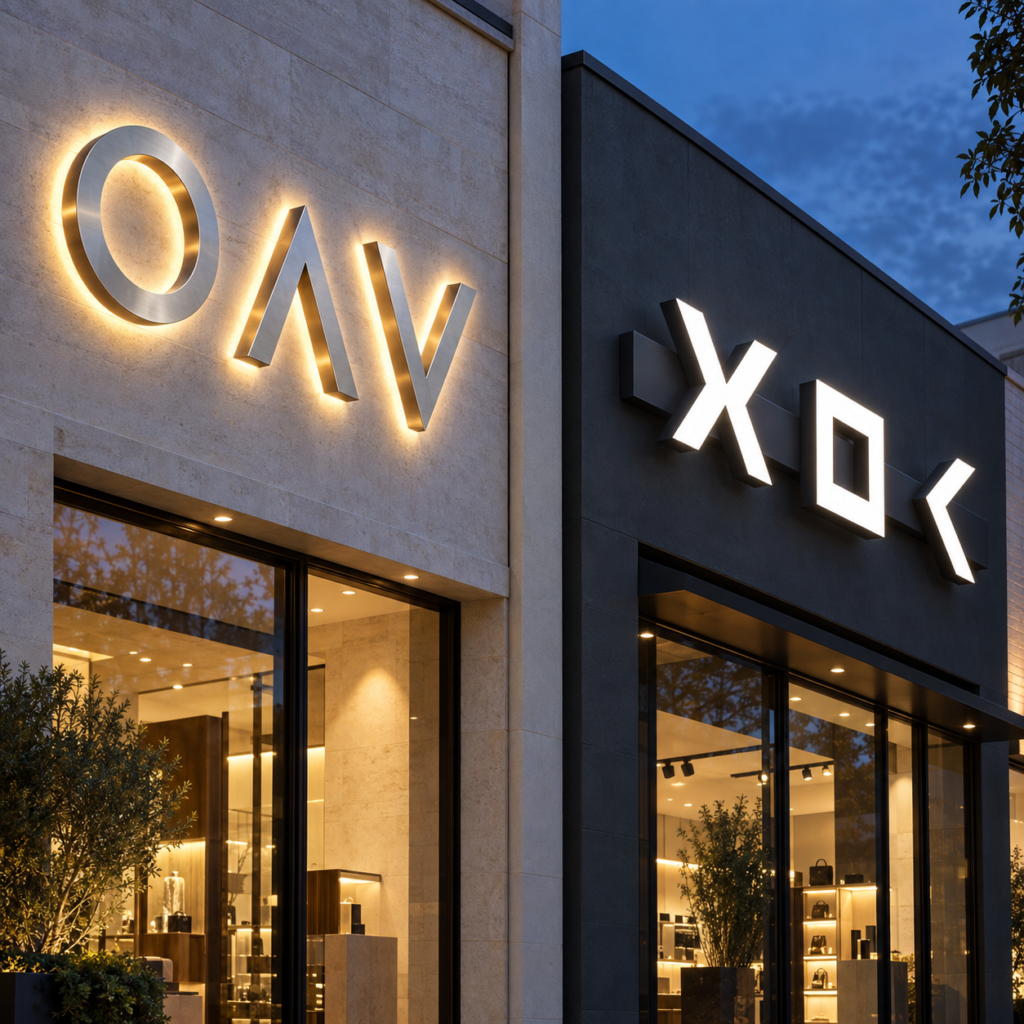
With flush mount channel letters, a customer sees the letters first. The wall remains the background, and the sign looks like it was designed as part of the architecture.
With raceway mounted channel letters, the customer sees the letters and a supporting channel. This can look clean and professional when the raceway is narrow, painted carefully, and aligned with the sign layout. It is often less suitable where a minimalist, floating-letter effect is essential.
For example:
- A luxury hotel entrance may benefit from individually mounted brushed stainless-steel backlit letters.
- A shopping-centre tenant sign may benefit from a raceway because it simplifies wiring and future tenant changes.
- A restaurant on a textured brick wall may use a raceway to avoid drilling many holes into the façade.
- A large front-lit sign on metal cladding may use a raceway for a faster and more controlled installation.
Which Mounting Method Costs Less?
There is no universal answer. The fabrication price, installation price, and wall-restoration cost should all be considered.
A raceway adds material and fabrication work, but it can reduce on-site drilling, wiring, and installation labour. Flush mounting removes the visible raceway but may require more individual cable holes, more accurate site work, and more time for installation.
Ask your supplier to quote both options when the project allows it.
| Cost Factor | Flush Mount | Raceway Mount |
|---|---|---|
| Sign fabrication | No raceway material | Includes fabricated raceway |
| Wall drilling | Usually more holes | Usually fewer fixing points |
| Electrical routing | Hidden behind individual letters | Managed inside or behind raceway |
| Installation time | Can be longer | Often faster |
| Future wall repair | More holes to repair if removed | Usually fewer holes to repair |
| Visual result | More architectural | More practical and serviceable |
For a temporary lease, a shopping-centre unit, or a façade that may change tenants later, raceway mounting may reduce future restoration work. For a long-term flagship location, flush mount channel letters may justify the extra installation planning.
How Lighting Type Affects the Mounting Decision
The lighting effect matters.
Front-Lit Channel Letters
Front-lit letters use illuminated acrylic faces. They are commonly selected for high visibility and longer viewing distances. Both mounting methods can work well.
For larger retail signs, a raceway is often practical because it groups the wiring behind the letters. Explore HLW’s front-lit LED channel letters for typical constructions.
Backlit Channel Letters
Backlit letters create a halo of light on the wall. Because the wall is part of the final visual effect, flush mounting is often preferred for premium installations. Correct stand-off distance, wall colour, cable position, and LED layout all affect the quality of the halo.
See HLW’s backlit sign options for suitable metal-letter constructions.
Front-and-Back-Lit Letters
Combination-lit letters have more wiring and internal components. A raceway, backer panel, or concealed support structure can be useful when the site cannot accommodate many individual wiring routes.
What Information Should You Give the Sign Factory?
Before HLW prepares drawings or a quotation, provide:
- Vector logo or final wording
- Overall width, height, and available installation area
- Wall photos, including close-up material details
- Indoor, covered outdoor, or full outdoor application
- Destination country and local input voltage
- Preferred effect: front-lit, backlit, or front-and-back-lit
- Preferred mounting method, or permission to recommend one
- Power-source location and cable route
- Whether the landlord permits drilling behind individual letters
- Required delivery date and installation schedule
If possible, show the back side of the wall or confirm whether cables can pass through it. This one detail often determines whether flush mount channel letters are realistic.
For outdoor projects, the mounting method must work together with weatherproof LED modules, sealed cable entries, drainage, and accessible power supplies. UL Solutions’ electric sign guidance is a useful reference for buyers who need to confirm electric-sign evaluation requirements in the United States.
How HLW Sign Helps Buyers Select the Right Mounting Method
HLW Sign is a source factory with more than 15 years of sign-manufacturing experience, an approximately 3,250 m² production facility, and export experience across more than 40 countries.
We manufacture custom front-lit letters, backlit letters, front-and-back-lit channel letters, acrylic signs, logo light boxes, and architectural signage from one set upward.
For each project, we can help confirm:
- Flush mount, raceway mount, or backer-panel construction
- Letter depth and metal-return material
- Acrylic face, stainless-steel, aluminium, or painted finish
- LED colour temperature and power grouping
- Cable exits, fixing points, and installation templates
- Outdoor sealing and drainage considerations
- Export-safe packing and numbered installation parts
Before shipment, we provide production drawings for approval and, for suitable illuminated projects, 24-hour lighting tests plus pre-shipment photos or videos. We also supply installation templates and mounting hardware according to the approved construction.
To request a quotation, send your artwork, wall photos, dimensions, destination country, voltage, and preferred lighting effect through our contact page.
FAQs
Is flush mounting better than raceway mounting?
Flush mounting usually gives the cleanest appearance because each letter is installed directly on the wall. Raceway mounting is often better when wiring management, fewer wall holes, faster installation, or future removal are priorities.
Are raceway mounted channel letters lower quality?
No. Raceway mounted channel letters can be high quality and are widely used for commercial storefronts. The correct choice depends on the wall, wiring route, installation conditions, and desired appearance.
Can a raceway be painted to match the wall?
Yes. The raceway can often be painted to match the façade, the letter returns, or the brand colour. It should be specified on the approved production drawing.
Are flush mount channel letters suitable for brick walls?
They can be, but the fixing method, cable route, drilling permission, wall condition, and backlit stand-off distance need to be checked before production.
Which option is easier to replace later?
A raceway can make replacement or removal easier because more wiring is concentrated in one support channel and there are usually fewer wall penetrations.
What do you need for a mounting recommendation?
Please send the logo file, overall sign size, wall photos, wall material, installation location, lighting effect, destination country, voltage, and available power-source position.