If you plan to import signs from China, preparing the correct customs, shipping and compliance documents before dispatch can help prevent clearance delays, unexpected charges and delivery problems. The exact requirements depend on the destination country, sign construction, electrical components, shipment value, packaging and selected Incoterm.
Most international sign shipments require a commercial invoice, packing list and transport document. Illuminated signs may also need technical specifications or electrical compliance records, while shipments packed with solid wood may require ISPM 15-compliant packaging.
This guide explains the documents normally required, who prepares them and what buyers should check before their custom signs leave the factory.
What Documents Do You Need to Import Signs from China?
The following table provides a practical overview of the most common sign import documents.
| Document | Prepared by | Main purpose | Usually required? |
|---|---|---|---|
| Pro forma invoice | Manufacturer | Confirms quotation and payment terms | Before ordering |
| Purchase order or contract | Buyer and seller | Records the commercial agreement | Recommended |
| Commercial invoice | Manufacturer/exporter | Declares products, value and origin | Normally required |
| Packing list | Manufacturer/exporter | Lists packages, dimensions and weights | Normally required |
| Bill of lading | Carrier or forwarder | Transport document for ocean freight | Sea shipments |
| Air waybill | Airline or forwarder | Transport document for air freight | Air shipments |
| Courier waybill | Express carrier | Identifies and tracks courier shipments | Courier shipments |
| Customs declaration | Importer or broker | Declares the shipment to customs | Normally required |
| HS classification information | Importer, broker and supplier | Supports tariff classification | Normally required |
| Certificate of origin | Exporter or authorized body | Confirms manufacturing origin | When requested |
| Insurance certificate | Insurer, buyer or seller | Confirms cargo coverage | When applicable |
| Compliance records | Manufacturer and importer | Supports product conformity | Market dependent |
| ISPM 15 information | Packaging supplier/exporter | Supports wood-packaging compliance | When applicable |
A customs broker may request additional documents based on local regulations. Buyers should confirm the checklist before production rather than waiting until the shipment arrives.
1. Pro Forma Invoice
The manufacturer normally issues a pro forma invoice before production begins. It is used to confirm the order and arrange payment, but it is not usually the final invoice used for customs clearance.
A professional pro forma invoice for custom signage should include:
- Seller and buyer information
- Sign type and quantity
- Overall dimensions
- Main materials
- Surface finish and color
- Lighting method
- LED color or color temperature
- Input voltage and plug standard
- Controllers and power supplies
- Installation accessories
- Production lead time
- Product price
- Freight cost
- Payment terms
- Incoterm and named destination
For example, the product description could state:
Custom stainless steel halo-lit channel letters with 3000K LED modules, external power supplies and installation templates.
This is more useful than an unclear description such as “advertising sign.”
Before paying the deposit, make sure the pro forma invoice matches the approved dimensions, materials, electrical specifications and shipping method.
2. Commercial Invoice
The commercial invoice is one of the most important commercial sign shipping documents. Customs uses it to review the transaction value, product description, seller, buyer, country of origin and other declaration information.
It should normally contain:
- Exporter’s legal company name and address
- Importer or consignee’s legal name and address
- Invoice number and date
- Purchase order reference
- Detailed product description
- Quantity and unit price
- Total product value
- Currency
- Country of origin
- HS code information, when confirmed
- Incoterm and named place
- Freight and insurance charges, when applicable
- Total invoice value
Businesses that import signs from China should avoid vague descriptions such as “LED goods,” “decorations,” “advertising products” or “samples.”
A clearer description would be:
Custom low-voltage LED illuminated channel letters with aluminum returns, acrylic faces, LED modules and external power supplies.
U.S. Customs and Border Protection recommends using precise cargo descriptions that allow customs officers to identify the merchandise. Importers can review the official CBP examples of acceptable cargo descriptions.
The declared value should reflect the genuine commercial transaction. Artificially reducing the invoice value can result in reassessment, penalties, seizure or clearance delays.
3. Packing List
The packing list shows how the signs and accessories have been packed. Customs officers, carriers, warehouses and customers use it to identify the contents of every crate or carton.
A complete packing list should include:
- Shipper and consignee
- Packing-list number and date
- Number of packages
- Packaging type
- Contents of each package
- Individual package dimensions
- Net weight
- Gross weight
- Total shipment volume
- Crate or carton numbers
- Shipping marks
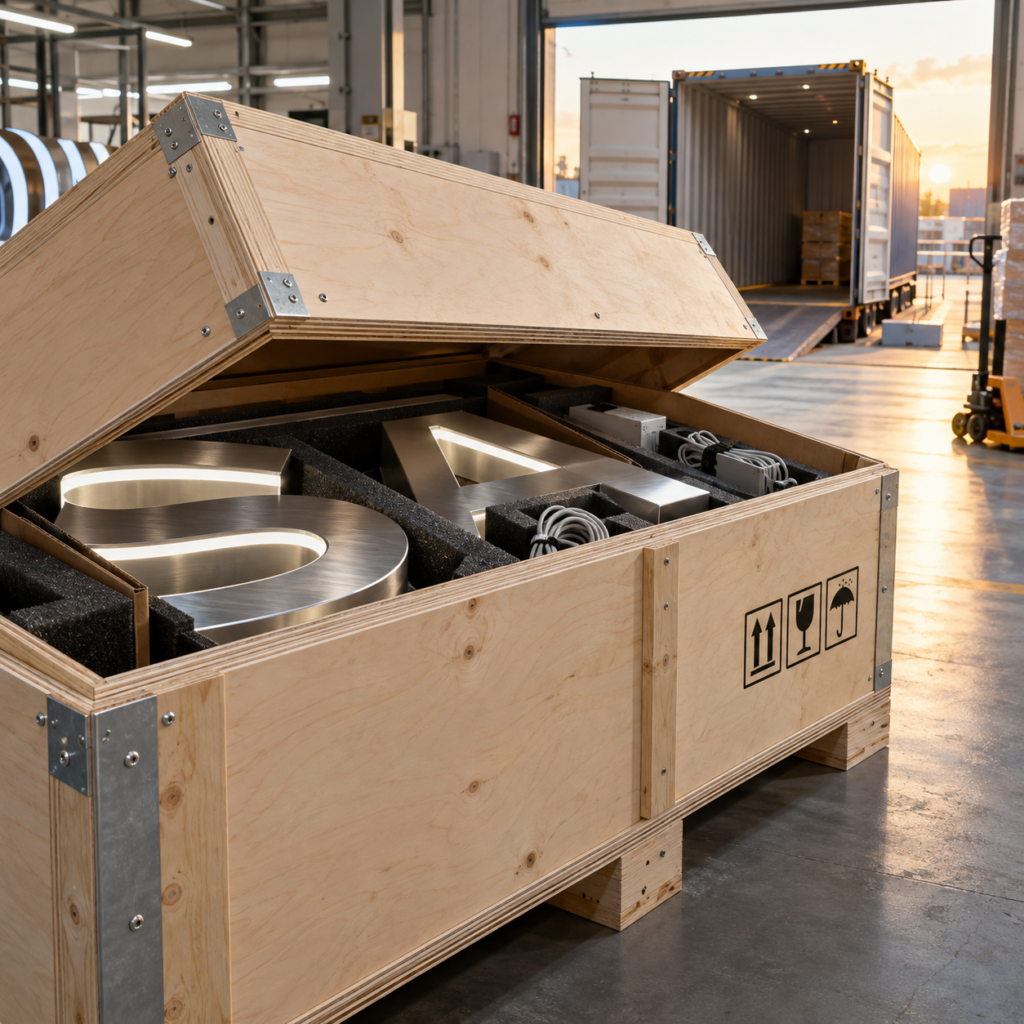
Large channel letters are often separated into several wooden crates to reduce the possibility of damage and control freight volume.
The packing list should also identify accessories such as:
- LED power supplies
- RGB controllers
- Remote controls
- Wiring
- Mounting studs
- Installation templates
- Screws and brackets
The quantities, weights and consignee information must be consistent across the commercial invoice, packing list and transport document.
4. Bill of Lading, Air Waybill or Courier Waybill
The required transport document depends on how the signs are shipped.
Ocean freight
For sea freight, the carrier or forwarder issues a bill of lading or sea waybill. It normally shows:
- Shipper
- Consignee
- Notify party
- Port of loading
- Port of discharge
- Package count
- Goods description
- Weight and volume
The buyer should confirm whether the shipment uses an original bill of lading, telex release or sea waybill.
Air freight
An air waybill records the air shipment. It is used by the airline, freight forwarder and customs-clearance parties.
Express courier
Courier shipments use a courier waybill and tracking number. The courier may contact the importer for identification, tax information or clearance authorization.
When you import signs from China, review the consignee’s legal name, address and telephone number before the transport document is finalized. A small error can delay delivery.
5. Customs Declaration and Importer Registration
The customs declaration is normally submitted electronically by the importer or an authorized customs broker.
The Chinese manufacturer supplies product and shipment information, but the importer usually remains responsible for satisfying the destination country’s customs and regulatory requirements unless the parties have agreed on a valid alternative arrangement.
Requirements differ by market.
United States
Buyers should review U.S. Customs and Border Protection’s importing guidance. Confirm:
- Who will be the importer of record
- Whether the entry is formal or informal
- Whether a customs bond is required
- How the goods should be described
- Whether country-of-origin marking is required
- Whether another government agency regulates any component
European Union
An EU customs declaration is the legal act used to place imported goods under a customs procedure. The European Commission provides current information on its official customs declaration page.
EU commercial importers commonly need an EORI number. They should also verify applicable VAT, product-compliance and responsible economic operator requirements.
United Kingdom
UK buyers can follow the government’s step-by-step guide to importing goods, including EORI registration, tariff classification and declaration requirements.
Canada
Canadian importers should review the Canada Border Services Agency’s commercial import guidance and current CARM registration requirements.
Australia
The Australian Border Force provides official information about requirements for importing goods, including import declarations and regulated products.
Because customs rules can change, buyers planning to import signs from China should confirm current requirements with a licensed customs broker.
6. HS Code and Product Classification Information
The HS code is used to classify imported merchandise and determine applicable duty rates, taxes, restrictions and reporting requirements.
It is normally declaration information rather than a certificate issued by the factory.
Sign classification can depend on:
- Whether the sign is illuminated
- Its primary function
- Main materials
- Electrical components
- Whether accessories are imported separately
- The tariff schedule used by the destination country
An illuminated sign, non-illuminated stainless steel letter, acrylic display and separate LED power supply may not use the same classification.
The manufacturer can provide:
- Product photographs
- Technical drawings
- Material details
- Lighting specifications
- Component list
- Power-supply information
- Intended product use
The importer or customs broker should make the final classification decision. Do not select an HS code only because it produced a lower duty rate on another shipment.
7. Certificate of Origin and Origin Marking
A certificate of origin confirms where the products were manufactured. It may be requested by:
- Customs
- A bank
- A letter-of-credit arrangement
- A tendering authority
- The buyer
- A preferential trade program
It is not automatically required for every sign shipment.
Country-of-origin marking is a separate issue. Some destinations require imported goods or packaging to show the manufacturing country.
If you import signs from China, ask your customs broker whether “Made in China” must appear on:
- The finished sign
- The rear panel
- Electrical accessories
- Individual packaging
- The shipping crate
Confirm this requirement before production so the label can be positioned without affecting the appearance of the sign.
8. Compliance Documents for Illuminated Signs
Product compliance documents are different from basic customs documents. The exact requirements depend on the sign, electrical system and destination market.
Possible supporting records include:
- Declaration of Conformity
- CE-related technical documents
- RoHS documentation
- EMC test reports
- Electrical-safety reports
- LED module data sheets
- Power-supply certificates
- IP test information
- Product labels
- Wiring diagrams
- Installation instructions
- Traceability records
European compliance
CE marking applies only to products covered by relevant EU harmonized legislation. It is not a universal import certificate for every sign.
The European Commission explains the responsibilities of manufacturers and importers in its official CE marking guidance.
Importers should review the completed sign as a system, including:
- Letter or light-box body
- LED modules
- Controllers
- Dimmers
- Power supplies
- Cables
- Connectors
North American electrical requirements
CE documentation does not replace local North American approvals.
Before you import LED signs from China for installation in the United States or Canada, ask the installer or local authority having jurisdiction whether the project requires:
- UL- or CSA-listed power supplies
- Recognized LED modules
- A complete sign listing
- Field evaluation
- Local electrical permits
A component certificate does not automatically mean the complete custom sign has been certified as an assembled product.
9. Wood Packaging
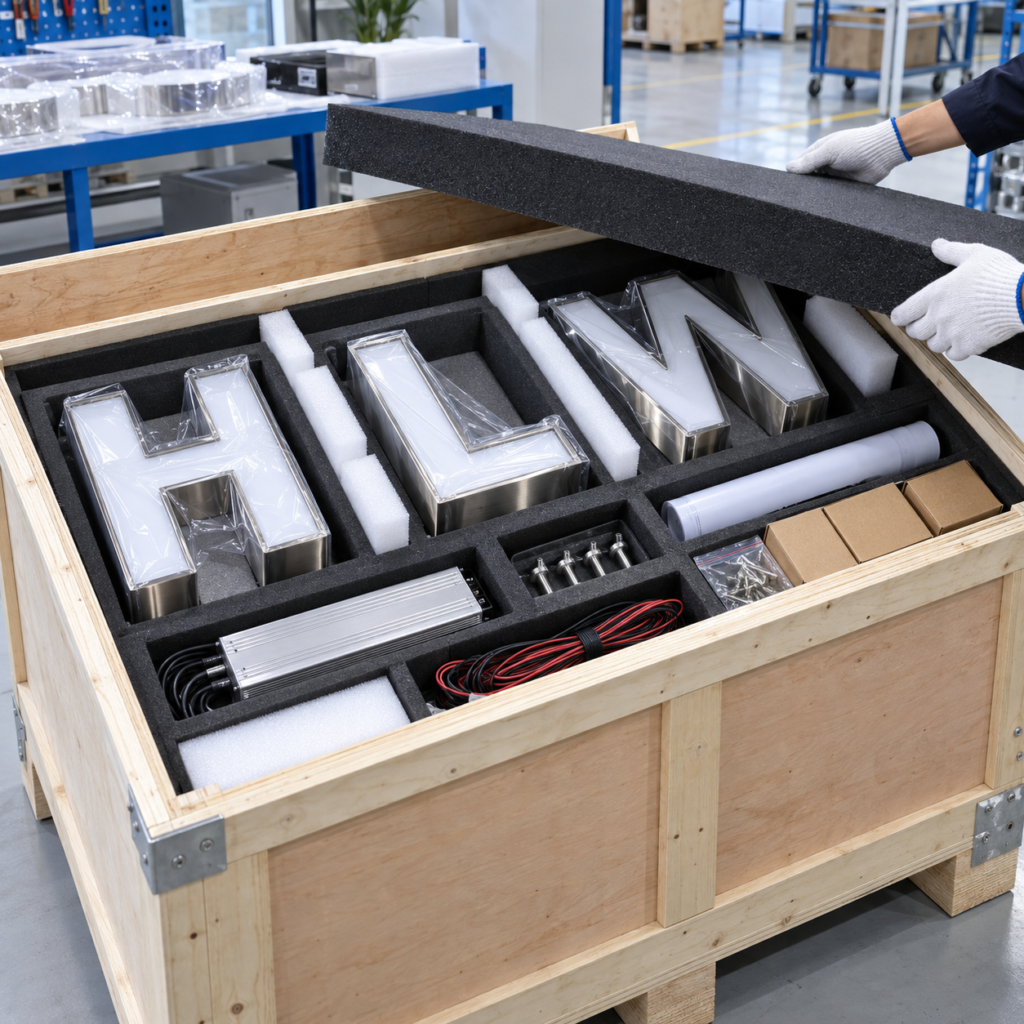
Plywood and other engineered wood products are often treated differently from raw solid wood. However, a plywood crate can still include solid-wood supports or blocks.
Ask the manufacturer to confirm:
- What materials are used in the crate
- Whether it contains solid wood
- Whether regulated wood has been treated
- Whether the mark is visible and legible
Failure to meet wood-packaging rules can lead to inspection, treatment, re-export or destruction at the importer’s expense.
10. Cargo Insurance Certificate
An insurance certificate may be required when cargo insurance has been purchased or when the selected Incoterm requires one party to arrange insurance.
Buyers should check:
- Insured value
- Covered transportation route
- Exclusions
- Deductible
- Claim deadline
- Required photographs
- Proof-of-damage requirements
Custom signs are made for a particular brand, size and finish. If they are damaged, they usually cannot be replaced from inventory.
Photograph the crates before unpacking. If there is visible damage, record it on the carrier’s delivery document before signing.
Additional Documents for Installation and Acceptance
Some documents are not required for customs clearance for signs, but they help prevent installation errors after delivery:
- Approved production drawing
- Artwork approval
- Color and finish confirmation
- Wiring diagram
- LED layout
- Power-supply layout
- Installation template
- Mounting instructions
- Accessory checklist
- Quality-control photographs
- Lighting-test video
- Warranty statement
Before ordering, buyers can compare HLW’s:
Selecting the correct structure early makes it easier to prepare accurate product descriptions, electrical information and commercial sign shipping documents.
How Incoterms Affect Import Responsibilities
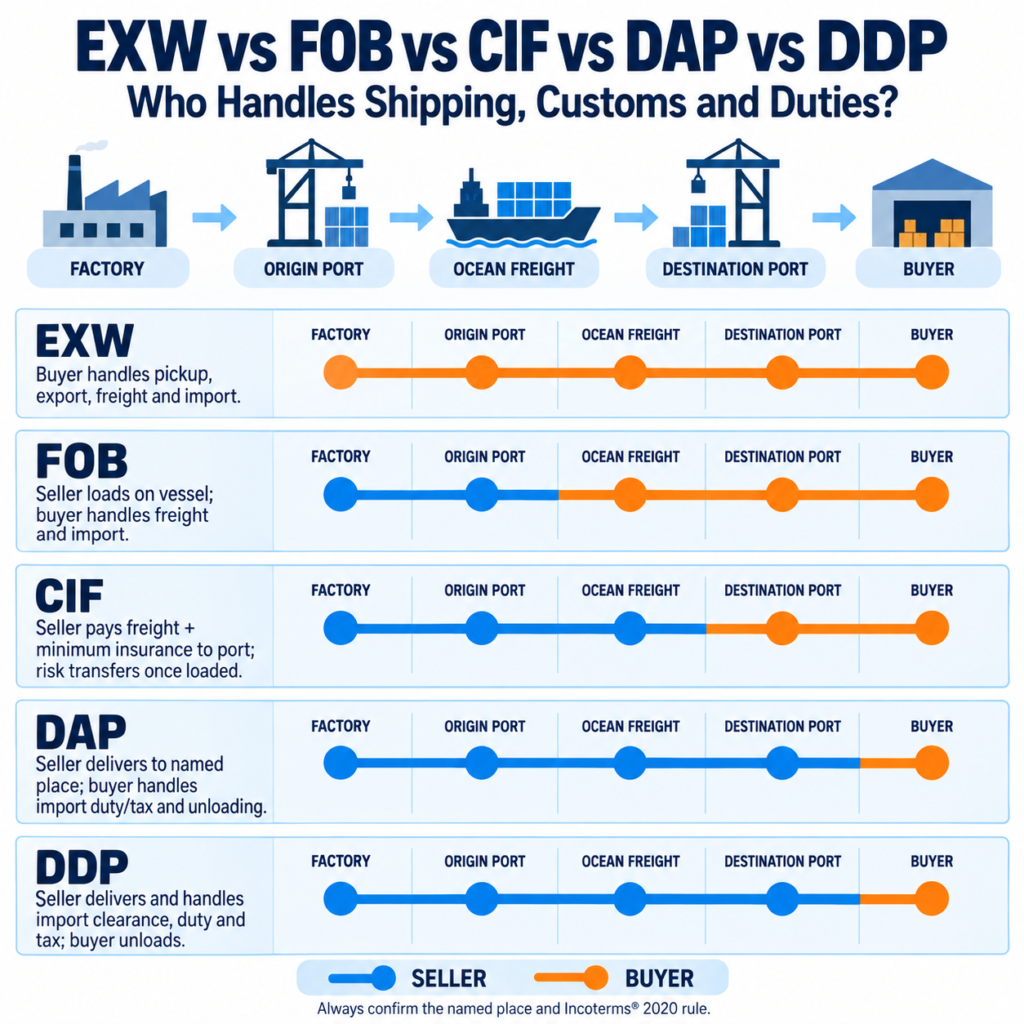
Incoterms define how transportation costs, risks and responsibilities are divided between buyer and seller. They do not replace customs law or product-compliance obligations.
The quotation or contract should include the Incoterm version and named place. The International Chamber of Commerce provides the authoritative reference for Incoterms rules.
EXW
Under EXW, the buyer takes responsibility for most transportation and export/import arrangements.
FOB
Under FOB, the seller handles agreed origin-side obligations until the goods are loaded at the named port. The buyer arranges main freight and import clearance.
CIF
The seller arranges ocean freight and the required minimum insurance to the named destination port. The buyer normally handles import clearance and destination costs.
DAP
The seller arranges transportation to the named destination. The buyer normally handles import clearance, duties and taxes.
DDP
Under DDP, the seller is responsible for import formalities and applicable import charges. However, local law may still require a locally eligible importer, tax number or importer-of-record arrangement.
Companies that import signs from China under DDP terms should confirm:
- Who acts as importer of record
- Whose tax or registration number is used
- Whether duties are included
- Whether VAT or GST is included
- Whether customs brokerage is included
- Whether remote-area charges are included
- Whether unloading and installation are excluded
Always specify the delivery address. “DDP Europe” is unclear; “DDP to the buyer’s confirmed address in Madrid, Spain” is more precise.
Document Preparation Timeline
Before paying the deposit
- Confirm the buyer’s legal company name.
- Confirm the delivery address.
- Select the sign type and dimensions.
- Confirm voltage and plug standard.
- Choose the Incoterm.
- Ask a broker about destination requirements.
Before production approval
- Approve the artwork and technical drawings.
- Confirm materials and finishes.
- Approve the LED color or color temperature.
- Confirm power supplies and controllers.
- Confirm required compliance records.
- Decide where origin labels should be placed.
Before shipment
- Review the commercial invoice.
- Check the packing list.
- Confirm the importer and consignee.
- Review the draft transport document.
- Verify package dimensions and weights.
- Send document copies to the broker before arrival.
Following this process makes it easier to import signs from China without last-minute document corrections.
Common Documentation Mistakes
Using an unclear product description
“LED sign” may not provide sufficient information. Identify the sign type, main materials and lighting configuration.
Using inconsistent information
Quantities, values, package counts, weights and consignee details should match across all documents.
Using the pro forma invoice for clearance
The commercial invoice should reflect the finished products actually shipped.
Assuming one certification works worldwide
CE, UKCA, UL and CSA do not have identical purposes. Confirm the requirements of the destination market.
Appointing a broker too late
Early broker review allows the factory to correct descriptions, labels or supporting documents before dispatch.
Ignoring electrical specifications
Voltage, frequency, plug type and power-supply approvals should be confirmed before production.
How HLW Sign Supports International Orders
HLW Sign has manufactured custom illuminated and non-illuminated signage since 2010. Our product range includes channel letters, metal logos, light boxes, RGB signs, neon-style signs and custom architectural signage.
When customers import signs from China through HLW, our team can provide:
- Free design support
- Product quotation and pro forma invoice
- Technical drawings
- Material and electrical information
- Commercial invoice
- Detailed packing list
- Shipping-document coordination
- Installation templates
- Product photographs and videos before dispatch
- 24-hour lighting testing
- Export wooden-crate packaging
- Available compliance documents, subject to product confirmation
- Courier, air, sea and selected door-to-door shipping options
Our normal production time for many custom sign projects is approximately 7–15 working days after design and payment confirmation. The exact schedule depends on quantity, size, structure and finish.
The importer or appointed broker should confirm the final HS classification, customs value, importer registration, taxes and destination-market compliance obligations.
Send your logo file, dimensions, installation location, destination address and preferred lighting effect through the HLW contact page to receive a project-specific quotation and shipping plan.
Frequently Asked Questions
Is it difficult to import signs from China?
It is generally manageable when the buyer, manufacturer and customs broker confirm the product information and documents before shipment. Problems usually occur when descriptions, values, classifications or consignee details are incomplete.
Do I need an import license?
Not every country requires a general import license for ordinary commercial signs. However, importer registration, customs declarations and product-specific regulations may apply.
Is a certificate of origin always required?
No. It may be requested by customs, a bank, a tendering organization or for a preferential tariff claim.
Do I need CE documents for an LED sign?
CE documentation may be relevant when a product covered by applicable EU legislation is placed on the European market. The EU importer should verify which rules apply to the finished sign.
Can I use the HS code suggested by the factory?
The factory can provide technical information and a suggested classification. The importer or customs broker should confirm the final code under the destination tariff schedule.
Do I need a customs broker?
A broker is not mandatory for every shipment. However, professional brokerage is recommended for first-time importers, commercial freight, high-value orders and illuminated signs with electrical compliance questions.
Can HLW arrange DDP shipping?
DDP and other door-to-door solutions may be available for many destinations. Availability depends on the destination, shipment size, product type and local import requirements.
Final Checklist to Import Signs from China
Before the signs leave the factory, confirm that you have:
- A correct commercial invoice
- A detailed packing list
- The applicable transport document
- Confirmed HS classification
- An identified importer of record
- Customs broker authorization, when required
- Importer registration
- Required compliance documents
- Certificate of origin, when necessary
- Country-of-origin markings
- Wood-packaging information
- Cargo insurance confirmation
- Approved production drawings
- Installation instructions
- Complete accessory list
For buyers asking how to import signs from China, the safest approach is to begin with the commercial invoice, packing list and transport document, and then add the records required by the destination, sign construction and agreed delivery term.
Preparing the documentation before shipment is one of the most effective ways to reduce customs delays, control import costs and ensure the signs are ready for installation after delivery.