
Choosing between a neon sign and front-lit channel letters is not simply a matter of deciding which one looks better. The right option depends on where the sign will be installed, how far away it must be seen, the visual character of the brand, local weather conditions, installation requirements and the available budget.
From a professional sign factory’s perspective, these two products solve different problems. A custom neon sign produces a continuous, expressive line of light and is especially effective for decorative graphics, handwriting-style logos and interior feature walls. A front-lit letter is a three-dimensional illuminated letter built for clarity, scale and strong storefront visibility.
This neon sign vs frontlit letter guide explains the materials, construction, brightness, durability, maintenance and best applications of both products. It also provides a practical checklist to help buyers select the right illuminated signage before requesting a quotation.
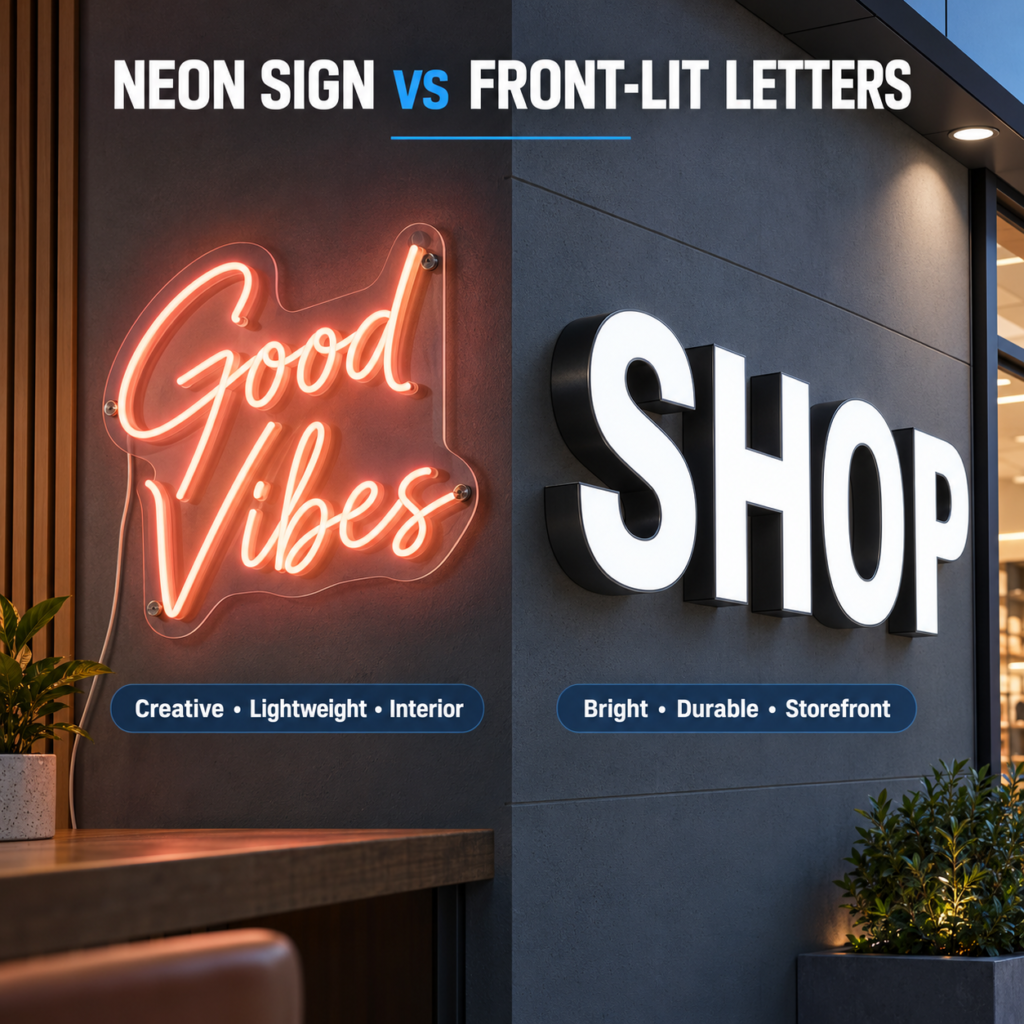
What Is a Neon Sign?
The term “neon sign” can refer to two different technologies: traditional glass neon and modern LED neon flex.
Traditional neon is made by heating and bending glass tubes, filling them with neon or another gas and powering them through high-voltage transformers. It creates a distinctive glow, but the glass is fragile, production is highly dependent on manual craftsmanship and international shipping can be difficult.
Modern custom LED neon signs use flexible silicone or PVC light strips containing LEDs. The strip is mounted into a groove in a clear acrylic, PVC or metal backing. This construction recreates the smooth linear appearance of glass neon while operating at a safer low voltage, commonly 12V or 24V. As explained in the official ENERGY STAR guide to LED lighting, LEDs are directional light sources whose efficiency and long-term performance depend heavily on good product design and thermal management.
At HLW Sign, silicone LED neon is commonly available in 6 mm, 8 mm and 12 mm widths. A narrow strip can reproduce finer graphics, while a wider strip gives stronger visibility and is more suitable for larger signs. Single-color, RGB and RGBW lighting can be supplied depending on the design and controller.
Main advantages of a neon sign
- It creates a warm, artistic and recognizable atmosphere.
- Continuous light lines work well for script fonts and outline graphics.
- LED neon is lightweight and relatively easy to mount.
- RGB versions can display changing colors and dynamic lighting effects.
- Low-voltage LED neon is more energy-efficient and safer than glass neon.
- It is effective as a photo background or interior decorative feature.
Main limitations of a neon sign
- Thin, crowded or highly detailed artwork may not be manufacturable.
- Visibility can be weaker than channel letters in bright daylight.
- Large solid letter faces cannot be reproduced with a single light line.
- Flexible strips can age faster if low-quality silicone or LEDs are used.
- Outdoor waterproofing requires careful treatment of joints, cable exits and controllers.
- The appearance can feel decorative rather than architectural.
What Is a Front-Lit Letter?
A front-lit channel letter, also known as a face-lit channel letter, is a three-dimensional fabricated letter with light passing through its front face. A typical construction includes an aluminum or stainless-steel return, an aluminum or metal back, internal LED modules and a translucent acrylic face.
The face is normally made from 3–5 mm acrylic, although the exact thickness depends on letter size and engineering requirements. The sides may be painted, powder-coated, brushed or electroplated. LEDs are arranged inside the letter to illuminate the face evenly without visible dark areas or excessive hotspots.
Front-lit letters are commonly used on retail stores, supermarkets, restaurants, shopping centers, hotels, offices and other commercial façades. They remain easy to read during the day because the acrylic face carries the brand color even when the LEDs are switched off.
Main advantages of front-lit letters
- Strong readability in both daytime and nighttime conditions.
- Better long-distance visibility for storefronts and roadside locations.
- Three-dimensional construction creates a professional architectural appearance.
- Colors, letter depth, faces and returns can be customized.
- Individual letters can follow the original logo and brand proportions.
- Properly built outdoor letters can reach IP65 or IP67 protection levels.
- LED modules and power supplies can be serviced or replaced separately.
Main limitations of front-lit letters
- Production and installation are more complex than for a small neon sign.
- Every letter requires wiring unless a raceway or unified back structure is used.
- Very thin strokes and small text may not provide enough internal space for LEDs.
- Large letters require stronger packaging and can increase shipping costs.
- Uneven LED spacing or insufficient letter depth may create visible light spots.
Neon Sign vs Frontlit Letter: Quick Comparison
| Comparison | LED Neon Sign | Front-Lit Letter |
|---|---|---|
| Visual character | Artistic, casual and atmospheric | Bold, dimensional and architectural |
| Light appearance | Continuous line or outline | Even illuminated face |
| Daytime visibility | Moderate, depending on backing | Strong because of the colored acrylic face |
| Night visibility | Bright at close and medium distances | Strong at medium and long distances |
| Best size | Small to medium | Medium to very large |
| Common location | Interior wall, window, bar or feature area | Storefront, façade, mall or commercial building |
| Fine details | Limited by neon strip width and bending radius | Limited by stroke width and internal LED space |
| Outdoor suitability | Possible with proper waterproof construction | Very suitable with IP65/IP67 construction |
| Installation | Usually one complete backing panel | Individual letters, raceway or wireway |
| Maintenance | Strip sections or controllers may need replacement | LED modules and power supplies are replaceable |
| Shipping | Usually lighter, but acrylic needs protection | Heavier and requires stronger packaging |
| Brand impression | Creative and social-media friendly | Established, professional and highly visible |
Neon Sign vs Frontlit Letter: Design Style and Brand Personality
The most important difference in the neon sign vs frontlit letter decision is visual language.
LED neon follows lines. It is ideal for handwriting, signatures, simple icons, short phrases and outline-style graphics. It gives cafés, bars, salons, gyms, entertainment venues and event spaces a relaxed and expressive identity. It is especially effective when customers are expected to photograph and share the sign.
Front-lit letters create illuminated surfaces rather than lines. They preserve the solid mass of a logo and communicate scale, stability and professionalism. This makes them a stronger choice for supermarkets, restaurants, dealerships, shopping centers, offices and retail chains.
If the brand requires a premium corporate façade, front-lit letters usually provide the more substantial result. If the goal is an artistic interior focal point, LED neon may create more personality at a lower weight.
Neon Sign vs Frontlit Letter: Brightness and Viewing Distance
Brightness should be evaluated in relation to ambient light and viewing distance, not only by looking at a close-up photo.
A neon sign concentrates light in narrow lines. Indoors or at night, the contrast can be excellent. However, direct sunlight and bright commercial environments may reduce the visibility of thin neon strokes. Increasing brightness alone does not always solve this problem because the illuminated area remains narrow.
A front-lit letter has a much larger luminous face. The colored acrylic remains visible during daylight, while the internal LED system makes the full face readable at night. For customers viewing a sign from a moving vehicle or across a large parking area, front-lit letters normally provide better recognition.
When evaluating neon sign vs frontlit letter for an exterior storefront, buyers should provide the factory with the installation height, total viewing distance, surrounding lighting and a daytime photo of the building. These details help determine the correct letter height, depth and LED configuration.
3. Materials and Manufacturing Structure
The quality of either sign depends heavily on materials that may not be visible in a rendering.
For LED neon, important components include the grade of silicone, LED density, acrylic or metal backing thickness, soldered connections, waterproof end caps, cable exits, controller and power supply. Poor-quality silicone may discolor, harden or crack. Inconsistent LED spacing may produce dark sections along the line.
For front-lit letters, buyers should evaluate the metal type and thickness, acrylic face, return depth, internal LED layout, bonding method, drainage, waterproofing and access for maintenance. Aluminum is lightweight and corrosion-resistant, while stainless steel provides a more premium finish and stronger fabricated appearance.
As an experienced custom sign manufacturer, HLW Sign normally uses 12V or 24V branded LED modules and tests the complete sign continuously for 24 hours before packing. For outdoor projects, power supplies and connections should be placed in protected, serviceable positions rather than permanently sealed inside inaccessible walls.
Neon Sign vs Frontlit Letter: Outdoor Durability and Weather Resistance
Outdoor use can change the answer to the neon sign vs frontlit letter comparison.
An LED neon sign can be made for outdoor installation, but the production team must seal every cut point, end cap, connector and cable exit. The backing panel must also withstand wind and temperature changes. Large acrylic backings may flex or crack, so outdoor signs sometimes require an aluminum or stainless-steel support structure.
Front-lit letters are naturally suited to exterior façades when correctly manufactured. Metal returns protect the internal LEDs, while the acrylic face provides a large weather-resistant illuminated surface. Drainage holes, waterproof LED modules and correctly located power supplies help reduce moisture problems.
For coastal, snowy or high-humidity locations, buyers should specify the environment before production. Marine-grade 316 stainless steel may be appropriate for severe salt exposure. IP65 is suitable for many outdoor LED signs for business, while IP67 components may be recommended where exposure is more demanding. The IP designation comes from the international ingress-protection classification defined by the International Electrotechnical Commission; the rating should apply to the relevant components and enclosure design rather than being treated as a general marketing label.
5. Size, Stroke Width and Artwork Feasibility
Not every logo can be directly converted into either construction.
LED neon has a minimum bending radius and requires adequate space between adjacent strokes. Very small corners, narrow gaps and crowded text may need to be simplified. Depending on the strip size and design, the factory may recommend increasing the overall dimensions or separating complicated elements.
Front-lit letters also require minimum stroke widths because LEDs, wiring and structural returns must fit inside. For small English letters, approximately 3 cm is often a practical minimum overall height, although actual feasibility depends on the font. Small Chinese characters normally require greater dimensions. Narrow strokes may need to be widened to achieve even illumination.
Before comparing price, send the factory a vector file in AI, EPS, PDF or SVG format. A professional supplier should conduct a manufacturability review and clearly mark any lines, corners or text that require adjustment.
6. Color and Lighting Effects
Both products support a wide range of colors, but they display color differently.
LED neon produces a saturated line of light. Single-color options are simple and reliable, while RGB or RGBW neon can display dynamic effects controlled by a remote, app, SPI, TTL or DMX system. RGBW is useful when the customer needs both colorful effects and a cleaner dedicated white channel.
Front-lit letters use the combination of acrylic face color and LED color. White acrylic with white LEDs provides a clean appearance. Colored acrylic can be paired with a matching LED color for stronger saturation. Day/night acrylic can appear black when unlit and illuminate white or another color at night.
When comparing neon sign vs frontlit letter, remember that a digital rendering cannot perfectly reproduce real LED color. Buyers should confirm acrylic samples, metal finishes and color temperatures such as 3200K warm white, 4500K neutral white or 6500K cool white before production.
Neon Sign vs Frontlit Letter: Installation and Wiring
LED neon signs are often supplied as a complete panel with pre-installed lighting. Small indoor signs may require only mounting screws and one power cable. This makes installation convenient for shops, event spaces and rented properties.
Individual front-lit letters require more planning. Each letter may be connected separately behind the wall, installed on a raceway or assembled on a custom wireway or back panel. A raceway reduces the number of wall penetrations and can combine the electrical components into one serviceable structure. Individual flush mounting creates a cleaner appearance but requires accurate drilling and hidden wiring.
For overseas buyers, the factory should provide a full-size installation template, numbered wiring diagram, mounting hardware and power supplies compatible with the destination voltage. HLW Sign can also design a unified structure with one main power connection when the project requires simplified installation.
8. Maintenance, Service Life and Warranty
No illuminated sign is completely maintenance-free. Good design makes future servicing predictable.
In an LED neon sign, a damaged strip section may require removal from the backing groove and replacement with a matching color and specification. RGB signs also include controllers, amplifiers and additional wiring, which makes troubleshooting more complex than with a single-color system.
In a front-lit letter, individual LED modules can normally be replaced by opening the face or service panel. A modular layout means one failed component does not necessarily require replacement of the entire letter set.
Component quality, operating temperature, daily working hours, ventilation and voltage stability all affect service life. HLW Sign provides a two-year warranty for LED modules and a one-year warranty for power supplies, with replacement parts sent when a covered component is confirmed to be defective.
9. Cost and Total Project Value
There is no universal winner in the neon sign vs frontlit letter cost comparison.
A small LED neon sign with a standard acrylic backing is often more economical because it uses fewer fabricated metal components and can be shipped as one panel. However, complicated artwork, RGB controls, thick custom backing or an outdoor metal frame can increase the price.
Front-lit letters generally involve more fabrication, including metal cutting, bending, welding, painting, acrylic forming, LED layout and individual assembly. Shipping and installation may also cost more. In return, they provide stronger storefront visibility, a more architectural appearance and easier modular servicing.
Buyers should compare total project value instead of product price alone. Include packaging, shipping, duties, installation labor, electrical work, expected maintenance and the commercial value of day-and-night visibility. DDP shipping can simplify customs clearance and landed-cost planning for international projects.
Which Businesses Should Choose a Neon Sign?
A neon sign is usually the better choice when:
- The sign is primarily for an interior wall or window.
- The design uses handwriting, outlines or a short slogan.
- The brand wants a creative, youthful or social-media-friendly atmosphere.
- Customers will view the sign from a short or medium distance.
- The installation needs to be lightweight and relatively simple.
- RGB animation or changing colors are important.
- The sign is intended as décor as well as identification.
Typical applications include bars, cafés, beauty salons, gyms, gaming rooms, studios, wedding venues and reception feature walls.
Which Businesses Should Choose Front-Lit Letters?
Front-lit letters are normally the stronger choice when:
- The main purpose is storefront identification.
- The sign must remain readable in direct daylight.
- Customers will see the sign from a road or parking area.
- The project requires large individual letters.
- A dimensional and professional building appearance is important.
- The sign will face long-term outdoor weather exposure.
- Individual components must be accessible for future maintenance.
Typical applications include supermarkets, restaurants, hotels, retail chains, offices, shopping centers, dealerships and large commercial buildings.
What Should You Consider Before Choosing?
Use the following checklist before deciding between neon sign vs frontlit letter:
- Installation location: Is the sign indoors, outdoors, behind glass or directly exposed to rain?
- Viewing distance: Will people see it from two meters away or from across a road?
- Daytime visibility: Does the sign need to remain prominent when the LEDs are off?
- Brand style: Should it feel artistic and informal or dimensional and architectural?
- Artwork complexity: Are the strokes wide enough for the chosen manufacturing method?
- Overall dimensions: Can the sign be produced and shipped as one piece, or should it be divided?
- Lighting color: Is single color, RGB, RGBW or a specific white color temperature required?
- Wall construction: Can individual letters be wired through the wall, or is a raceway necessary?
- Weather exposure: Are higher waterproofing or corrosion-resistant materials required?
- Maintenance access: Can LEDs, controllers and power supplies be reached after installation?
- Electrical standard: Is the system compatible with the destination voltage and plug type?
- Total landed cost: Does the budget include packaging, shipping, duties and installation?
Factory Recommendation: Do You Have to Choose Only One?
Some projects benefit from combining both technologies. For example, a storefront can use front-lit letters for the main business name and LED neon for a slogan, opening message or decorative icon. The front-lit letters provide long-distance brand visibility, while the neon element creates atmosphere at close range.
The two systems should still be designed as one coordinated sign package. Color temperature, brightness, mounting depth, cable routes and control systems should be confirmed together. A factory rendering should show both daytime and nighttime views, but final production should be based on approved technical drawings rather than the rendering alone.
Frequently Asked Questions
Is LED neon brighter than front-lit channel lettering?
LED neon can look very bright because its light is concentrated in a narrow line. However, front-lit channel letters usually provide a larger illuminated surface and better long-distance visibility, especially on commercial façades.
Can both sign types be used outdoors?
Yes. Both can be manufactured for outdoor use, but materials, cable exits, connectors, power supplies and mounting structures must be designed for the actual environment. Front-lit letters are generally more suitable for large, permanent exterior applications.
Which option is easier to install?
A small neon sign mounted on one backing panel is usually easier. Front-lit letters require an installation template and more detailed wiring, although a raceway or unified back structure can simplify the work.
Which option looks more premium?
For a building façade, fabricated front-lit letters normally create a more substantial and architectural appearance. For an interior feature wall, a well-designed neon sign can look highly distinctive and premium.
Can the factory reproduce any logo exactly?
Not always. Neon strips have bending and spacing limits, while front-lit letters require enough width and depth for LEDs. A manufacturability check should be completed before price and production drawings are finalized.
Final Verdict: Neon Sign vs Frontlit Letter
The best choice depends on function rather than trend. Choose an LED neon sign when you want continuous lines, expressive graphics, simple installation and a strong decorative atmosphere. Choose front-lit letters when you need solid daytime branding, long-distance readability, large dimensions and durable architectural signage.
From a factory perspective, the most successful projects begin with complete information: vector artwork, required size, installation photos, wall dimensions, viewing distance, lighting color, electrical standard and delivery address. These details allow the sign structure to be engineered correctly and help prevent unnecessary design revisions, installation difficulties and unexpected costs.
If you are still comparing neon sign vs frontlit letter, contact HLW Sign for a free sign design and quotation. With more than 15 years of manufacturing experience, we can review your artwork, recommend a suitable construction and provide a quotation based on your installation environment. MOQ is one set, CE and RoHS-compliant components are available, and optional DDP delivery can be arranged for international projects. Buyers supplying products to the European market can also consult the European Commission’s official explanation of the RoHS Directive, which restricts specified hazardous substances in electrical and electronic equipment.