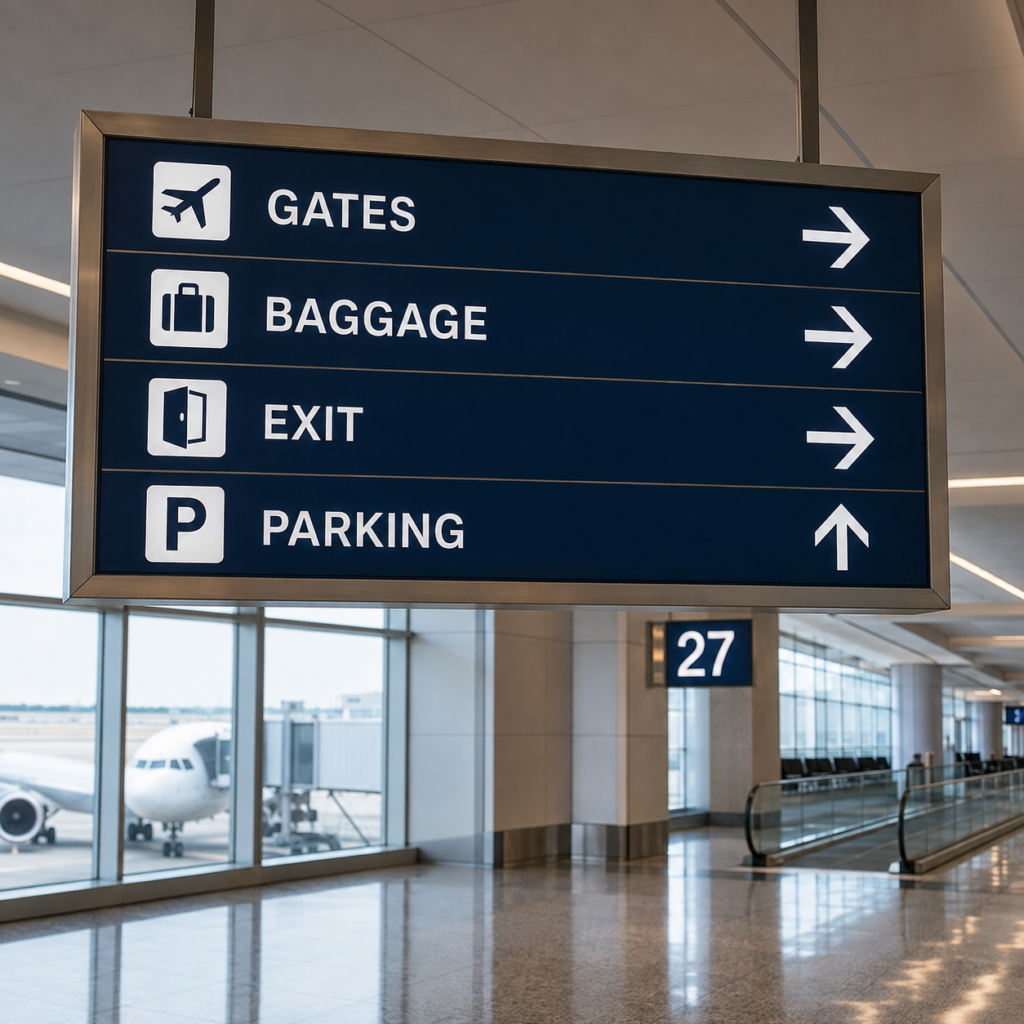


Airport signage is not a place for attractive guesses. Airport signage and markings must be selected for the exact operating zone, not simply for appearance or a low initial quote.
When a storefront sign is hard to read, a business loses attention. When an airfield sign or marking is wrong, faded, poorly positioned, or built to the wrong specification, it can create a safety and compliance problem. These are not comparable jobs, and treating them as comparable is how airport projects go sideways.
Buyers often send a basic drawing and ask for “airport signs” as if every sign on the property needs the same material and construction. It does not. Airfield operational signs, runway and taxiway markings, terminal wayfinding, parking signs, and commercial concession signage each have different requirements. The first job is to separate them before anyone talks about price.
This guide explains how to approach airport signage and markings without making the costly mistake of using a commercial-sign mindset on an aviation-safety project.
1. Airport Signage and Markings: Start by Separating Airfield and Terminal Uses
This distinction controls everything that follows.
Airfield signs and pavement markings guide aircraft and vehicles on runways, taxiways, aprons, and holding areas. They are operational visual aids. In the United States, the FAA’s active AC 150/5340-18H, Standards for Airport Sign Systems, addresses the siting, design, and installation of signs on airport runways and taxiways. The FAA’s AC 150/5340-1M covers standards for markings on runways, taxiways, and aprons.
Terminal signage is different. It helps passengers find check-in, gates, baggage claim, parking, restrooms, retail areas, and ground transportation. It must be durable, readable, and coordinated with the airport’s wayfinding system, but it is not a substitute for airfield operational signage.
If the quotation does not clearly state which category the product belongs to, stop there. A generic illuminated letter manufacturer should not be expected to decide an airfield compliance requirement from a logo file.
2. Sign Colors Are Not Decoration—They Carry Instructions
On the airfield side, color combinations are part of a controlled visual language. They must not be chosen because they “match the airport brand.”
The FAA Aeronautical Information Manual identifies six airfield sign types: mandatory instruction, location, direction, destination, information, and runway distance remaining signs. Mandatory instruction signs use a red background with white inscriptions to identify entrances to runways or critical areas, and locations where aircraft are prohibited from entering without clearance. See the FAA’s airport-sign guidance.
For markings, the FAA distinguishes runway markings from taxiway and holding-position markings. In general, runway markings are white, while taxiway and holding-position markings are yellow. This is functional information, not a visual preference.
| Project Area | What It Must Do | Main Risk if You Get It Wrong |
|---|---|---|
| Runway/taxiway sign | Direct aircraft or vehicle movement | Safety and compliance failure |
| Pavement marking | Identify movement areas and hold positions | Poor visibility or incorrect guidance |
| Terminal wayfinding | Help passengers navigate quickly | Confusion, missed connections, poor experience |
| Airport retail sign | Promote a business or service | Weak visibility and brand inconsistency |
3. Airport Signage and Markings Need More Than an “Outdoor Grade” Label
“Outdoor grade” is a sales phrase, not an airport specification.
For terminal-facing signs, it can be a reasonable starting point: you may need corrosion-resistant metal, UV-stable acrylic, weather-protected LEDs, and a mounting system suited to the wall or canopy. But for airfield products, the project team must define the required standard, visibility characteristics, electrical configuration, installation detail, and inspection criteria. Airport signage and markings cannot be specified responsibly with the words “make it weatherproof” alone.
Material selection still matters. For terminal signage, stainless steel is commonly chosen for its professional appearance and exterior durability. Painted aluminum can be useful when precise brand color, lower weight, or a non-metallic finish is needed. Acrylic faces and LED systems need to be selected for the intended exposure—not simply because they are the least expensive option.
For airport terminal logos, building letters, and commercial-area signs, explore HLW Sign’s backlit sign options and front-lit LED letters. These are commercial-sign solutions, not a claim of airfield operational compliance.
4. Airport Signage and Markings Can Fail Slowly—Then All at Once
The dangerous part of poor pavement marking is that it often looks acceptable until it does not.
Wear, rubber deposits, fuel exposure, snow removal, rain, UV exposure, and regular traffic can reduce visibility over time. Waiting until the marking is visibly poor during daylight is already too late for a serious maintenance decision. The right approach is to work from the applicable authority’s specification, inspection programme, and replacement criteria.
Do not accept a quotation that only says “reflective paint” or “airport road paint.” Ask what system is specified, what substrate preparation is required, how the markings will be applied, and how performance will be verified after installation. For FAA-governed work, the design and marking requirements must be reviewed against the current applicable FAA documents and the airport’s approved project requirements.
5. Airport Signage and Markings Inside the Terminal Need a Clear Hierarchy
Inside a terminal, the problem is rarely one missing sign. It is usually too many signs competing for attention.
Passengers make decisions while walking, pulling luggage, reading flight information, or navigating an unfamiliar building. A wayfinding system fails when every department adds its own font, colors, arrows, panel sizes, and mounting style.
For terminal wayfinding, use a hierarchy:
- Primary directions: gates, check-in, baggage claim, exits, transport
- Secondary directions: lounges, restrooms, services, retail zones
- Confirmation signs: gate numbers, zone names, room identifiers
- Commercial signs: concessions, brands, advertising, promotions
Keep operational wayfinding separate from commercial branding. A bright retail sign can attract customers, but it should not overpower a directional sign needed by travelers.
For a durable illuminated logo or storefront sign in an airport retail area, HLW Sign can customize acrylic letter signs and LED light box signs around the available wall, counter, or canopy structure.
6. Installation Planning Is Where Otherwise Good Signs Become Bad Projects
An airport sign can be correctly fabricated and still become a bad installation if cable routing, foundation details, access for maintenance, or mounting tolerances are ignored.
Before fabrication, confirm:
- Exact installation location and viewing direction
- Whether the product is airside, landside, terminal interior, parking, or retail
- Applicable authority, specification, and approval process
- Required sign dimensions, legends, colors, and photometric requirements
- Power source, voltage, conduit route, and access to power supplies
- Foundation, wall condition, wind exposure, and mounting method
- Maintenance access and replacement procedure
For a custom commercial sign, HLW Sign can provide drawings, mounting details, product photos, and a 24-hour lighting test before shipment. For any airfield safety sign, the airport engineer or qualified project authority must approve the design and installation requirements before production begins.
7. Factory Direct Does Not Mean “Skip the Technical Review”
Direct factory communication can reduce avoidable misunderstandings, particularly for terminal branding, airport retail, parking facilities, and architectural signs. It lets you confirm materials, finishes, illumination, mounting, and packaging without several layers of quotation handoffs.
But no factory-direct price is a reason to ignore the specification. If the sign is part of runway, taxiway, apron, or aircraft-movement operations, compliance and approved project documentation come before the factory’s preferred construction method.
The best supplier for an airport project is not the one that says “yes” to every drawing in one hour. It is the one that asks what the sign is for, where it will be installed, which standard applies, and who is approving it.
What to Send When Requesting an Airport Signage Quote
Send these details with the first inquiry:
- Airport area: airfield, terminal, parking, curbside, or retail
- Sign category and required standard or project specification
- Artwork, legend schedule, and drawings
- Dimensions, viewing distance, and mounting height
- Material and finish requirements
- Lighting, electrical, and environmental requirements
- Installation location photos and structural information
- Delivery country, timeline, and packaging requirement
If you need terminal, retail, parking, or architectural airport signage, contact HLW Sign with the installation photos and drawing package. We can help turn the approved concept into a practical fabricated sign.
FAQ
Can a standard sign factory make airport runway and taxiway signs?
Only if the project is built and approved to the applicable aviation authority’s current requirements. Airfield operational signage is not a generic custom-sign product. Confirm the specification, approvals, and responsibilities before ordering.
What is the difference between airport signage and airport markings?
Airport signage consists of installed visual signs, while airport markings are painted or applied visual guidance on runways, taxiways, aprons, and other surfaces. Both must follow the applicable project and authority requirements.
Can illuminated channel letters be used at an airport?
Yes, for terminal branding, airport retail, hotel, parking, office, and other commercial or architectural locations when designed for that application. They should not be confused with airfield operational signs.
What is the biggest buying mistake?
Treating all airport signs as the same product. First classify the project. Then match the supplier, materials, standards, and installation process to that category.
Build the Right Sign for the Right Airport Zone
Airport signage and markings are not one purchasing category. Airfield visual aids protect operations; terminal wayfinding protects passenger flow; commercial signs protect brand visibility. Mixing these jobs together leads to weak quotations and avoidable rework.
For custom terminal, parking, retail, or architectural signage, contact HLW Sign to discuss materials, lighting, drawing support, and export-safe packaging. For airfield operational products, begin with the airport authority’s current approved specifications and technical review.