Most businesses do not lose visibility because their logo is bad. They lose visibility because the sign cannot be read when customers actually need it—after sunset, from a parking lot, or while driving past the building.
That is why illuminated signs are not only a decorative upgrade. For many storefronts, restaurants, clinics, hotels, retail spaces, and service businesses, they are a practical visibility tool.
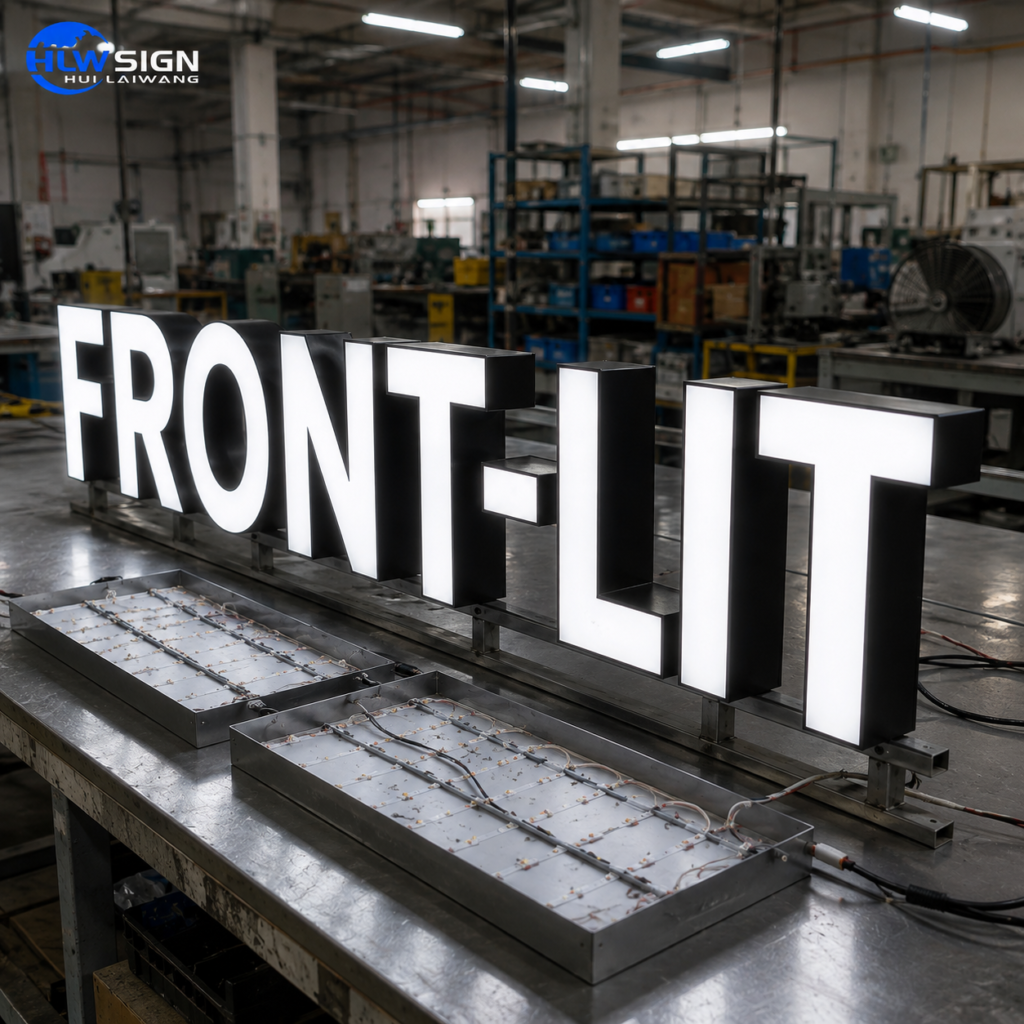
Front-lit channel letters are one of the most effective outdoor options. The LEDs shine directly through the acrylic face, making the business name clear at night while maintaining a professional three-dimensional appearance during the day.
The Problem: Your Sign Is Invisible When the Business Is Open
A non-illuminated sign can look clean in daylight, but it has one obvious limitation: when the surrounding light disappears, so does the brand name.
This becomes a costly issue for businesses that operate in the evening, such as restaurants, cafés, bars, gyms, convenience stores, salons, hotels, and medical clinics. Customers may see the building but miss the business name completely.
The solution: front-lit channel letters
Front-lit letters are illuminated signs with an acrylic face, internal LED modules, metal or aluminum returns, and a back panel. When powered on, light shines directly through the front face toward customers.
This creates stronger readability than a standard halo-lit sign and is especially useful for road-facing storefronts and commercial façades.
View HLW Sign’s Front-Lit LED Letters to explore custom styles.
Why Outdoor LED Signs for Business Need More Than Bright LEDs
Many buyers focus only on brightness. They ask for “strong LEDs,” but do not ask about acrylic thickness, letter depth, LED spacing, cable protection, or mounting method.
The result can be a sign that looks bright in one letter and uneven in another.
Common problems with poorly designed illuminated signs
- Dark areas inside large letters
- Visible LED hot spots through the acrylic face
- Uneven brightness between thin and wide strokes
- Water reaching the cable connection or power supply
- A sign that is difficult and expensive to install
- A face color that looks wrong when illuminated
The LED modules are important, but the complete internal structure is what determines the final effect.
What should be confirmed before production
For reliable outdoor led signs for business, the factory should check:
- Letter size and return depth
- Minimum stroke width
- Acrylic face color and thickness
- LED module spacing
- Required brightness and viewing distance
- Wall material and installation height
- Local voltage and cable route
- Indoor, outdoor, coastal, or high-humidity environment
HLW Sign provides free design support to review these details before cutting metal.
Front-Lit Letters Solve the Road-Visibility Problem
Backlit letters are elegant, but their main effect is a halo on the wall. If your customers need to read the sign from across a road or parking lot, a halo may not be enough.
Front-lit letters shine directly toward viewers. This is why they are widely used as outdoor led signs for business where clear nighttime identification matters.
| Business Situation | Recommended Sign Style | Reason |
|---|---|---|
| Roadside restaurant | Front-lit channel letters | Strong direct visibility at night |
| Retail storefront in a busy mall | Front-lit or dual-lit letters | Competes with surrounding signs |
| Corporate reception wall | Backlit letters | Softer and more architectural |
| Hotel building entrance | Front-and-back-lit letters | Premium halo plus clear face lighting |
| Coastal outdoor façade | Front-lit letters with 316 option | Visibility plus environment-specific material |
If your project needs both direct brightness and a premium halo, front-and-back-lit letters combine the two effects.
For a softer lighting style, compare our Backlit Sign collection.
Material Choices That Prevent Outdoor Problems
The visible sign face is only one part of the product. For outdoor illuminated signs, the metal return, acrylic face, LED modules, back panel, wiring, sealant, and mounting hardware must work together.
Stainless steel or aluminum returns
304 stainless steel is a common choice for many outdoor commercial signs. It provides a durable, premium finish and can be brushed, mirror-polished, painted, or electroplated.
For coastal or high-humidity projects, 316 stainless steel should be considered. Salt exposure, rain, and constant moisture can create problems when the material grade and sealing method are not matched to the site.
Aluminum is another practical option when lower weight is important, especially for larger sign structures.
Acrylic faces
The acrylic face controls the daytime color and nighttime light diffusion. White, warm white, red, blue, green, yellow, black day-night acrylic, and other custom colors are available.
The face color should be tested with the selected LED color. A blue acrylic face with white LEDs, for example, creates a different effect from the same acrylic with blue LEDs.
Read more about custom stainless steel metal letters and available finishes.
Water Protection: The Detail Buyers Often Miss
A sign can use waterproof LED modules and still fail outdoors if the cable exits, power supply, or letter joints are not protected.
For outdoor LED signs for business, the complete electrical system should include:
- Waterproof LED components
- Sealed wire connections
- Protected power-supply location
- Suitable drainage and ventilation details
- Correct wall mounting
- Stable mounting hardware
The IEC IP rating guide explains how IP ratings classify protection against dust and liquids. However, an IP rating should not replace sensible sign construction and proper installation.
Installation Can Add Cost—or Save It
A good sign should arrive ready to install, not ready to redesign at the job site.
Individual front-lit letters can be mounted with concealed studs for the cleanest appearance. But if behind-wall wiring is difficult, a raceway or backboard may be a better option.
| Mounting Method | Best Use | Main Advantage |
| Individual stud mounting | Clean façade with rear access | Premium appearance with concealed wiring |
| Raceway mounting | Limited wall access | Simplifies wiring and installation |
| Backboard mounting | Uneven wall or complex logo | Organizes letters and cable routes |
| Support frame | Rooftop or freestanding sign | Adds strength for larger projects |
Before production, ask for a letter-location drawing, mounting template, wiring diagram, and power-supply specification. This helps avoid installation delays and unexpected electrician costs.
Factory Direct Support for Custom Illuminated Signs
HLW Sign has manufactured custom signage since 2010. We help customers develop illuminated signs that are practical to fabricate, ship, install, and maintain.
For custom Front-Lit Channel Letters, we can provide:
- Free design support
- 201, 304, and 316 stainless-steel options
- Aluminum, acrylic, and custom finish options
- Warm white, cool white, single color, RGB, and RGBW lighting
- Installation templates and wiring information
- Pre-shipment lighting tests
- Photos or videos for confirmation
- Secure export packaging
The goal is not simply to make the letters light up. It is to make sure they remain clear, stable, and appropriate for the real installation environment.
Read our LED Channel Letters guide or contact HLW Sign for a free quotation.
Frequently Asked Questions
Are front-lit letters suitable as outdoor LED signs for business?
Yes. Front-lit letters are a strong choice for outdoor business signage because their acrylic face provides direct brightness and clear nighttime readability.
What is the best material for outdoor illuminated signs?
304 stainless steel and aluminum are commonly used for standard outdoor projects. For coastal or high-humidity locations, 316 stainless steel may be more suitable.
Can front-lit letters use RGB lighting?
Yes. RGB and RGBW LED systems can provide selectable colors and dynamic lighting effects through a compatible controller.
Why do some illuminated signs have dark areas?
Dark areas usually result from insufficient letter depth, poor LED spacing, narrow strokes, incorrect acrylic selection, or an LED layout not designed for the actual letter shape.